
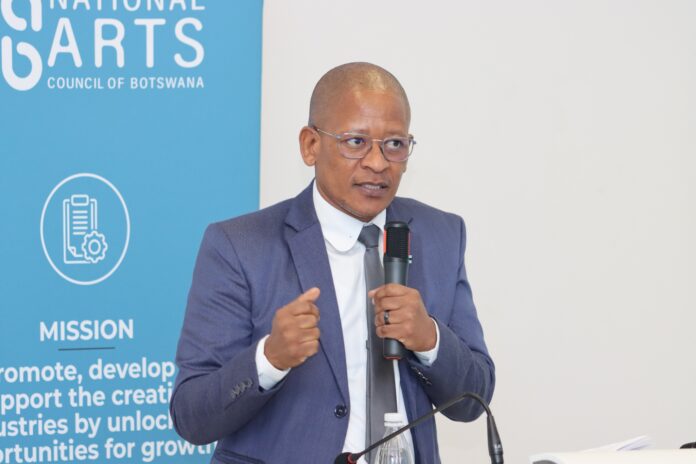

The National Arts Council of Botswana unveiled a bold strategic roadmap that will guide the Council from 2026 onward, signalling a decisive shift toward commercialisation, sustainability, and operational excellence within Botswana’s creative sector. This will cement the Council’s mandate to develop, promote and protect the creative and cultural sector through industry facilitation and various partnerships, programs , grants and initiatives
In his inaugural address, CEO, Gaokgakala Daniel Lemmenyane, emphasised that the arts must be positioned not only as a cultural pillar but as a viable economic driver, “Our responsibility is to transform creativity into enterprise, talent into trade, and artistic excellence into sustainable livelihoods. We must move from supporting isolated projects to building structured industries.” As part of this transformation, the Council has launched a nationwide Arts and Creative Industry Registry to collect comprehensive data on artists and creative enterprises across Botswana. The Registry will provide evidence required to design informed policies, allocate funding more equitably, measure the sector’s economic contribution to the Gross Domestic Product (GDP), and ensure that artists are accurately profiled and positioned within a structured national ecosystem.
In efforts to move towards commercialisation of the creative sector, the Council announced the establishment of the Botswana Creative Arts Fund, which will evolve from traditional grant system to a more strategic investment mechanism.
In efforts to move towards commercialisation of the creative sector, the Council announced the establishment of the Botswana Creative Arts Fund, which will evolve from traditional grant system to a more strategic investment mechanism. The Fund will prioritise scalable and export-ready projects, support innovation across disciplines, and introduce transparent funding processes anchored in measurable impact and long-term sustainability. Additionally, the Council will establish an Investment Company under the Council’s oversight. This entity will enable participation in commercially viable ventures, particularly in infrastructure development, including entertainment centres, performance venues, studio facilities, and multi-purpose creative hubs. These assets will operate on sustainable business models, generating revenue through rentals, events, and commercial partnerships. Income generated will be reinvested directly into the creative sector, reducing reliance on government funding, and building long-term industry wealth.
Anchored on strengthened governance, sustainable funding, artist capacity development, infrastructure expansion, and cultural preservation, the Council’s 2026 roadmap reflects a commitment to accountability, innovation, and measurable growth. The CEO called on government, private sector partners, development stakeholders, media, and artists to collaborate in realising a shared vision of a structured, investable, and globally competitive creative economy.


