
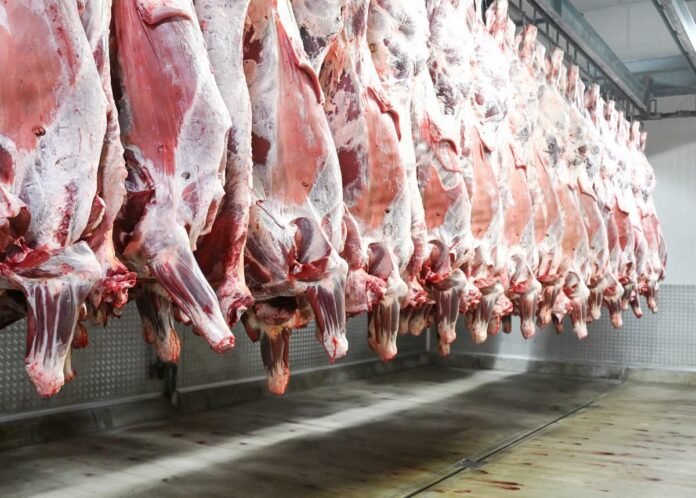


Beef exports could suffer losses of approximately P93 million (US$6.89 million) for every US$100 million (approximately P1.35 billion) in baseline exports as the country faces the combined threat of El Niño recurrent drought and ongoing Foot-and-Mouth Disease (FMD) disruptions.
The warning is contained in the Ministry of Finance’s 2027/2028 Budget Strategy Paper which reveals potential economic consequences of deteriorating weather conditions, particularly for agriculture, livestock production and the country’s meat-processing industry.
The paper warns that El Niño presents a downside risk to Botswana’s agricultural recovery and could increase food prices and drought-relief costs during 2027, with effects potentially extending into 2028.
“The cited RMB assessment anticipates intensification in late 2026 and early 2027,” the paper states.
Botswana’s exposure is heightened by recurrent drought and existing FMD disruptions, which have already placed considerable pressure on the agricultural sector.
It, however, warns that “Actual effects will depend on rainfall, water availability, regional food supplies and policy responses; El Niño does not necessarily result in drought.”
Botswana’s exposure is heightened by recurrent drought and existing FMD disruptions, which have already placed considerable pressure on the agricultural sector.
According to the paper, agriculture contracted by 13.4 percent in the first half of 2026, while the baseline projects growth of negative 9.5 percent in 2026 and 2.2 percent in 2027, excluding an additional El Niño shock. Although agriculture accounts for about two percent of GDP, the Ministry warns that its links to rural incomes, food security, meat processing and exports broaden the potential economic impact.The Ministry’s moderate scenario paints an even bleaker picture, assuming an additional weather shock on top of a baseline that already includes FMD disruptions. Under this scenario, agricultural growth falls to negative 11.8 percent in 2026 and negative 10.3 percent in 2027. In the second half of 2026, the contraction deepens from 5.6 percent under the baseline to 10.2 percent. The paper estimates that agricultural output will fall 2.5 percent below baseline in 2026, 14.5 percent in 2027 and 7.1 percent in 2028. Crops account for about 72 percent of the 2027 shortfall, reflecting their larger assumed weather sensitivity and a 41.7 percent share of agricultural value added. The impact is also expected to spill over into manufacturing, particularly meat processing, which is heavily dependent on livestock production.
Meat output is projected to fall 8.0 percent below baseline in 2027 and remain 5.5 percent below baseline in 2028 as livestock and processing constraints persist.
The Ministry’s simulations estimate that the beef-export shortfall would translate into approximately US$6.89 million (P96.6 million) for every US$100 million (P1.40 billion) in baseline exports.
Applied to the cited baseline of 5.4 percent, inflation would reach approximately 6.2 percent, with additional quarterly pressure peaking at 1.44 percentage points in the fourth quarter of 2027. The Ministry also highlights historical evidence showing that food inflation can rise even when headline inflation eases.
0The paper warns that inflationary effects will build with a lag as production shortages pass through to food prices.
Under the moderate scenario, annual-average headline inflation increases by approximately 0.80 percentage points in 2027, including 0.68 percentage points through food inflation.
Applied to the cited baseline of 5.4 percent, inflation would reach approximately 6.2 percent, with additional quarterly pressure peaking at 1.44 percentage points in the fourth quarter of 2027. The Ministry also highlights historical evidence showing that food inflation can rise even when headline inflation eases.
“In 2015–2016, food inflation increased by 1.4 percentage points while headline inflation declined by 0.3 percentage points,” the paper states.
To mitigate the potential fallout, the Ministry recommends temporary, targeted assistance for households facing food insecurity and income losses, alongside measures supporting feed and water availability, veterinary controls and market access.


