
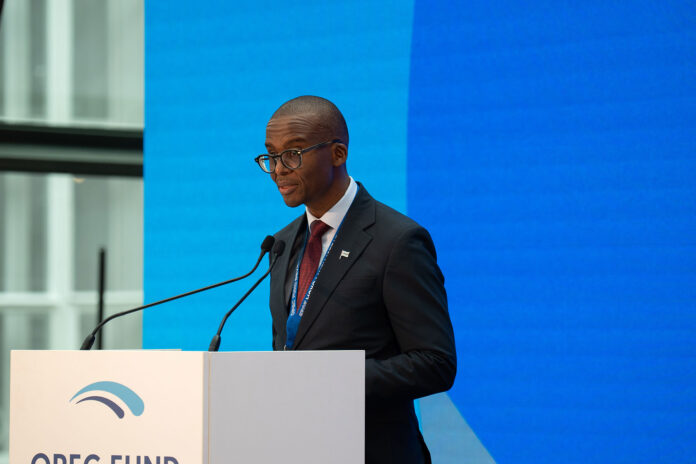


Vice President and Minister of Finance, Ndaba Gaolathe, has issued a strong call for global collaboration to address the widening digital divide and ensure Africa is not left behind in the accelerating pace of technological change. Delivering the keynote address at an international forum hosted by the OPEC Fund, Gaolathe positioned digital transformation as the cornerstone of Botswana’s economic future, warning that failure to act swiftly could entrench inequality and marginalize entire populations.
Referencing the lingering effects of the COVID-19 pandemic, accelerating climate instability, and the rapid evolution of artificial intelligence, Gaolathe said the world is undergoing a fundamental shift that demands new approaches to financing resilience, inclusivity, and innovation. He pointed to staggering global disparities in internet access, with over 2.6 billion people still offline and Africa lagging significantly in mobile internet coverage, as a symptom of deeper structural inequities.
“These are not only gaps in connectivity,” he said. “They represent missed opportunities in education, entrepreneurship, innovation, and voice.”
Gaolathe highlighted the urgency of preparing Africa’s youthful population—half of whom will be under the age of 25 by 2050—for a digital future. He warned that without deliberate inclusion in the development and governance of AI, Africa risks being digitally erased, as global algorithms increasingly dictate access to finance, education, and opportunity.
He cited Botswana’s national SmartBots strategy as a blueprint for inclusive digital transformation. Over 1.66 million Batswana—more than 70% of the population—are now connected to broadband. The government has reduced connectivity costs by over 94% and extended public Wi-Fi to hundreds of thousands weekly, connecting over 1,100 public facilities in 144 villages, with plans to reach 200 more by 2026.
“This is not infrastructure. This is transformation,” Gaolathe said, emphasizing that digital access is powering new waves of micro-enterprises, youth-led fintech and agritech ventures, and gig work.
He situated Botswana’s progress within a broader continental trend, applauding innovations like Kenya’s BasiGo electric buses, Rwanda’s electric motorbike taxis, and mobile-based agricultural solutions in Malawi and Zambia. These, he argued, form a continental movement toward sustainability, inclusion, and empowerment.
Beyond domestic transformation, Gaolathe said Botswana is positioning itself as a regional hub for climate-smart digital infrastructure, including carbon-neutral data centres powered by its vast solar potential. He invited international partners to co-invest in this vision, citing Botswana’s stable political environment, transparent institutions, and track record with multilateral financiers.
He emphasized the importance of ensuring Africa’s inclusion in the development of AI and data governance systems. “Representation in data is representation in the future,” he said, warning that algorithms trained without African languages, cultures, and contexts will exacerbate inequality.
Gaolathe pledged further investment in AI and digital skills, especially through technical and vocational training, and announced plans to digitalize Botswana’s healthcare system using AI to forecast outbreaks and improve service delivery.
He extended an invitation to global investors, sovereign wealth funds, and development banks to partner with Botswana in building scalable, inclusive digital and green infrastructure. “The future demands blended capital, shared expertise, and courageous trust in new frontiers,” he said.
Citing Botswana’s long-standing partnership with the OPEC Fund, Gaolathe confirmed the imminent signing of the Country Partnership Framework and expressed optimism about joint initiatives like the SMART Clean Cooking project. He concluded by asserting Africa’s readiness not just to participate in the digital revolution, but to lead with models grounded in culture, community, and moral clarity.
“From the Kgotla to the cloud, from the village to the virtual, our story is not one of catching up, it is one of standing up,” he said. “Let us code not just for commerce, but for compassion. Not just for now, but for posterity.”


