
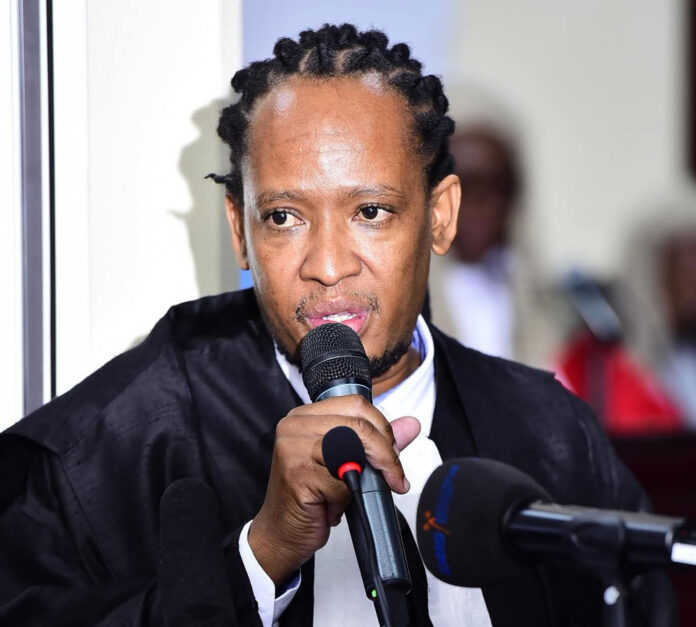


The chairman of the Law Society of Botswana has cautioned that the government’s push for a standalone Constitutional Court risks obscuring more urgent structural failures within the country’s justice system.
Speaking at the official opening of the Legal Year at the High Court in Gaborone, Lesedi Moahi said that while a Constitutional Court may be desirable in principle, constitutional reform must be approached deliberately and cannot substitute for fixing what he described as deepening dysfunction in judicial appointments, infrastructure and public accountability.
“A Constitutional Court does not exist to create law,” Moahi said, emphasizing that Parliament remains the supreme law making authority. “Its role is to interpret the Constitution and safeguard constitutional supremacy. Public discourse must properly contextualise that function.”
His remarks come amid renewed political momentum behind proposals to establish a Constitutional Court. Proponents have framed the court as essential for strengthening constitutionalism and protecting rights. The Law Society, however, has urged restraint, arguing that the urgency now being attached to the proposal risks overstating both its necessity and its immediate value.
Moahi warned that the country’s existing courts have historically been capable of adjudicating constitutional questions, and that constitutional safeguards remain intact within the current judicial framework.
Moahi painted a sobering picture of the local courts, describing deteriorating infrastructure, chronic understaffing and unreliable administrative systems that, taken together, are eroding public trust.
“The danger,” he said, “is that structural decay elsewhere in the justice system is being sidelined in favour of a symbolic reform.”
Moahi painted a sobering picture of the local courts, describing deteriorating infrastructure, chronic understaffing and unreliable administrative systems that, taken together, are eroding public trust.
Court buildings across the country suffer from neglect, he said, with some lacking basic amenities such as running water and sufficient stationery. Delays in replacing judges and support staff have left courts overstretched, while weak information and communications technology has hampered case management and efficiency.
“These are not minor inconveniences,” he said. “They undermine the dignity of judicial proceedings.”
Against that backdrop, he questioned whether introducing a new apex court should take precedence over addressing what he called pressing and unresolved challenges already afflicting the justice system.
The Law Society’s skepticism toward the Constitutional Court proposal is also shaped by recent controversy surrounding judicial appointments. Moahi said that in December 2025, the Judicial Service Commission convened an emergency meeting with little notice and appointed a judge without publicly advertising the position, a move he said violated assurances previously given by the Chief Justice.
Central to the Law Society’s position is the insistence that any constitutional reform, including the creation of a Constitutional Court, must be preceded by broad public consultation and education.
That episode, he said, had severely damaged trust between the Law Society and the administration of justice. The Society has resolved to seek legal redress to set aside the appointment and is considering withdrawing its representative from the Judicial Service Commission until clearer, binding rules governing appointments are adopted.
“These developments,” Moahi said, “must be viewed against broader structural concerns,” including the dominance of the executive in judicial appointments and the absence of transparent procedures.
Such conditions, he argued, raise serious questions about whether a Constitutional Court, if established under the same system, would inspire public confidence.
Central to the Law Society’s position is the insistence that any constitutional reform, including the creation of a Constitutional Court, must be preceded by broad public consultation and education.
Citizens, Moahi said, must be equipped to endorse or reject constitutional changes based on informed understanding, free from emotional, religious or partisan considerations.
Without that process, he warned, constitutional amendments risk deepening division rather than strengthening democracy.
Moahi made clear that silence, in the face of what he described as systemic weaknesses, would amount to a dereliction of duty.
“The urgency now being advanced,” he said of the Constitutional Court proposal, “risks diverting attention from the real work that must be done.”


