
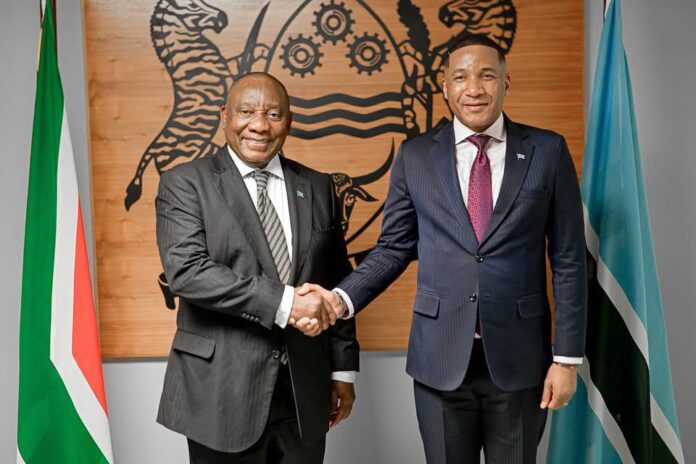


Botswana and South Africa used a high-level bilateral meeting in Gaborone this week to push for deeper economic cooperation as both countries confront global economic uncertainty, energy insecurity and growing pressure on the diamond industry.
At a state banquet on Tuesday night, South African President Cyril Ramaphosa described the visit as more than routine diplomacy.
The visit, Ramaphosa’s first state visit to Botswana since Boko took office, came as southern African economies confront slowing global demand, climate pressures, energy insecurity and growing concerns over the future of the natural diamond industry, a pillar of Botswana’s economy.
In his opening remarks at the commission session on Thursday, President Duma Boko said the region could no longer rely on old economic assumptions and needed stronger coordination to withstand global shocks.

“Across the world, nations are grappling with rising costs of living, energy insecurity, climate change, supply chain disruptions, technological transformation, and evolving geopolitical realignments,” Boko said.
He argued that the moment demanded “greater coordination, strategic foresight, and strengthened regional cooperation,” while also offering opportunities for Botswana and South Africa to reposition themselves in emerging industries, including renewable energy and digital innovation.
The leaders emphasized trade, infrastructure and energy integration as central to that effort. Botswana remains heavily economically linked to South Africa, which is its largest trading partner, but officials from both countries suggested the relationship had yet to reach its full potential.
“There remains substantial untapped potential for further expansion and diversification of trade and investment flows between our countries,” Boko said.
The commission discussions focused on cross-border electricity trade, transport corridors, agriculture and industrial cooperation, including efforts to streamline border operations and expand rail and road connectivity.
Ramaphosa echoed the bigger economic message, saying South Africa stood ready to support Botswana’s drive to diversify its economy and deepen regional commerce through frameworks like the African Continental Free Trade Area and the Southern African Customs Union.
But one of the most striking themes was the future of diamonds. Botswana and South Africa, among the world’s leading diamond producers, are increasingly confronting the rise of lab-grown diamonds and weakening global demand for natural stones. Boko warned that African producers must move beyond extraction and retain more value domestically through beneficiation and downstream industries. “It is imperative that we strengthen cooperation in local beneficiation, downstream value chains, marketing, and protection of long-term integrity and competitiveness of the natural diamond industry,” he said.
Ramaphosa echoed the bigger economic message, saying South Africa stood ready to support Botswana’s drive to diversify its economy and deepen regional commerce through frameworks like the African Continental Free Trade Area and the Southern African Customs Union.
“We must work together to seize the opportunities presented by the African Continental Free Trade Area,” he said during the banquet speech.
The visit also carried symbolic weight. Ramaphosa opened his remarks by paying tribute to former Botswana president Festus Mogae, who died recently, calling him “a gentle giant” and “an illustrious African and a global statesman.”
The two presidents repeatedly invoked the countries’ shared liberation history, with Ramaphosa recalling Botswana’s support for South Africans during apartheid.
“Botswana was an ally and friend of the South African people in our quest for justice, democracy and human rights for all,” he said.
For Boko, whose administration has sought to project a more assertive economic agenda since taking office, the commission meeting offered an opportunity to position Botswana not simply as a stable neighbor, but as an ambitious regional actor seeking new leverage in energy, trade and mineral policy.
“Our fortunes are intertwined and the possibilities of our cooperation are endless,” Ramaphosa said.


