

Botswana has long been the safari world’s conscience. Its low-volume, high-value model, small camps, vast concessions and strict limits on visitor numbers has made it a global reference point for responsible safari tourism. But twenty years into operating some of the country’s most remote camps, African Bush Camps Founder and CEO, Beks Ndlovu, thinks the industry is coasting.
For African Bush Camps, responsibility begins where compliance ends. “Paying fees is compliance,” says Ian Mills, who oversees the organization’s governance, sustainability, and operations. “But compliance alone does not equate to impact.”
It is a thoughtful but intentionally challenging message directed at peers operating within the same concession system and at a broader culture in which financial contributions can sometimes be seen as a substitute for deeper accountability.
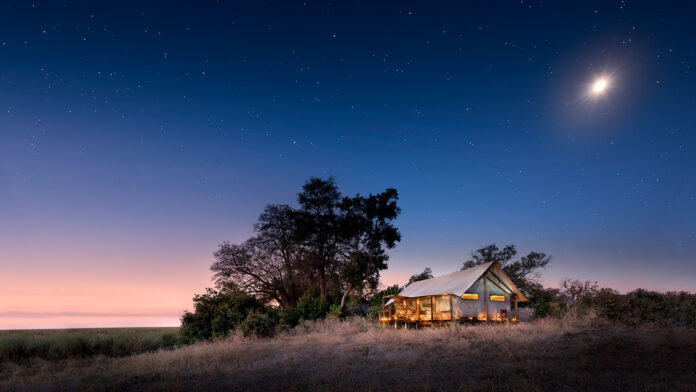
African Bush Camps operates across Botswana, Zambia, and Zimbabwe. In northern Botswana alone, the company holds its lease with the local community and manages more than 100 square kilometers of private concession land in the Linyanti Reserve.
Rather than expanding its holdings, African Bush Camps has spent recent years redesigning what it already has, moving beyond baseline obligations toward a model grounded in long-term stewardship, accountability, and measurable impact.
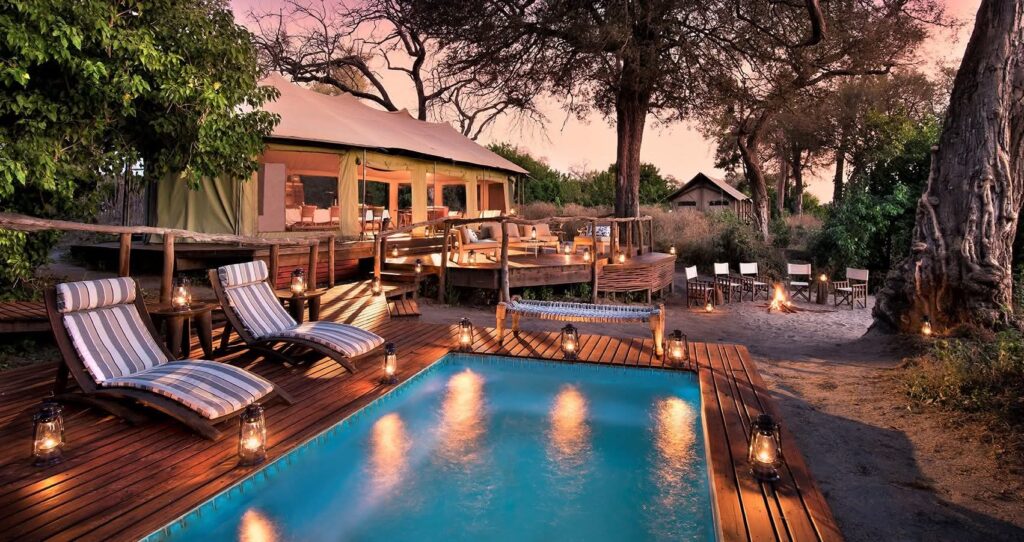
Its Linyanti portfolio, experiences that have operated for nearly two decades in one of the country’s most ecologically sensitive corridors, is being rebuilt with updated energy systems, including solar, biodigesters, and biochar initiatives.
“When we first established experiences like Linyanti Bush Camp and Ebony, we had limited resources and a very different understanding,” Ndlovu says. “Remaining static is not an option. Like any ecosystem, if you don’t progress, you risk extinction.”
The reimagining of Linyanti will see the company narrow its footprint to two standout properties: Linyanti Ebony, its Signature offering, and Linyanti Legodimo, its newest Icon Experience, opening in the same corridor in 2027. The move follows the local community’s decision to renew African Bush Camps’ lease for another fifteen years, a vote of confidence earned, not assumed, after nearly twenty years working in the area.
That evolution is not presented as a relaunch, but rather an acknowledgment that earlier models, built under different constraints, were no longer optimizing land, resources, or community outcomes.
“This is not reinvention for its own sake,” Ndlovu explains. “It is Linyanti reimagined, shaped by what the communities, the environment, and the market are asking of us now.”
Botswana’s concession model works differently from many other safari destinations. Operators compete for land through open tenders, setting out their own development plans and community commitments. The government does not prescribe what must be built or invested; it expects delivery on whatever was promised.
While overtourism has become the dominant anxiety in global travel circles, African Bush Camps believes the framing misses Botswana’s actual problem, which is strategy.
“Botswana’s tourism economy remains underdeveloped relative to its potential,” Ndlovu says. “The question is not whether to develop, it’s how.”
What the country needs, he argues, is clearer land-use planning grounded in ecological carrying capacity, with frameworks that operators genuinely honour rather than work around. That may mean revisiting the high-value, low-volume orthodoxy that has defined Botswana’s approach for decades.
“It doesn’t need to be abandoned,” Ndlovu says. “But it does need refinement. Tourism must serve people, ecosystems, and economies, simultaneously and sustainably.”
Botswana’s concession model works differently from many other safari destinations. Operators compete for land through open tenders, setting out their own development plans and community commitments. The government does not prescribe what must be built or invested; it expects delivery on whatever was promised.
“That tender becomes a pledge,” Ndlovu says. “And from there, you are expected to deliver.”
Beyond a mandatory six-percent resource royalty, there can be limited transparency on how fees flow back to communities. African Bush Camps says this places a direct moral burden on operators to go further, and to do so with structure, not sentiment.
The company ties its community funding to country-level budgets rather than seasonal occupancy, meaning investments in education, livelihoods, and enterprise development continue regardless of how full the camps are.
“When community development is not embedded into an organisation’s core purpose, it becomes transactional,” Ndlovu says. “That kind of giving is rarely transformative or lasting.”


Ian Mills is blunter still, noting that many operators view lease fees or trust contributions as the end of their responsibility.
“If everyone were genuinely reinvesting in communities and landscapes, we wouldn’t be facing the challenges we see today.”
Despite shared goals, genuine collaboration between operators remains limited across Botswana’s tourism sector. For Ndlovu, this represents one of the industry’s greatest missed opportunities.
“Collective effort has far greater impact than isolated action,” he says.
That belief led to the founding of Conservation Wildlife Fund and Africa Changemakers, two platforms designed to pool resources and amplify outcomes across operators.
“I would like to see a future where operators view each other less as competitors and more as co-stewards of shared landscapes,” he says.
As African Bush Camps marks twenty years of operations, Ndlovu has settled on a word to describe what comes next: stewardship.
“This phase is about depth, not unchecked growth,” he says. “It’s about optimising what we already have, for employees, communities, ecosystems, and national economies.”
For African Bush Camps, luxury is no longer defined by exclusivity alone, but by accountability, intention, and the courage to move beyond compliance.
“Tourism is not the goal,” says Mills. “It is the enabler. What truly matters is what we leave behind.”


