
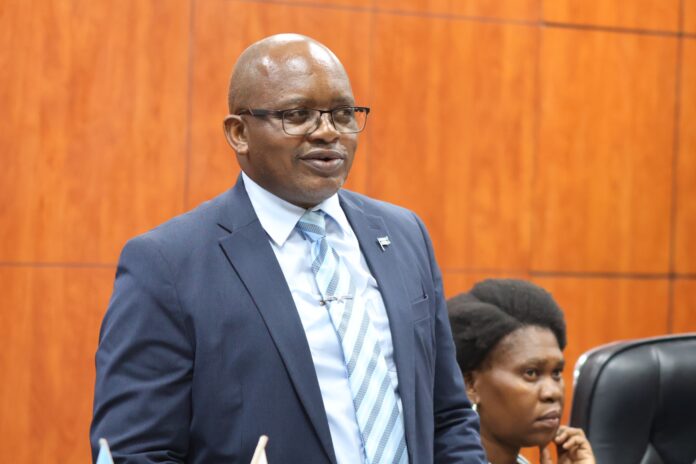

The long-running and emotionally charged debate over capital punishment is set to take centre stage in Parliament today, as Serowe South legislator Leepetswe Lesedi demands answers from the Minister of Justice and Correctional Services Nelson Ramaotwana over what he describes as an apparent moratorium on executions. Lesedi has tabled a series of pointed questions to the Minister of Justice and Correctional Services, seeking clarity on Government’s official position regarding capital punishment and whether Botswana has, in practice, suspended the death penalty.
At the heart of his parliamentary question is whether a formal or informal moratorium has been imposed. Botswana remains one of the few countries in the region that retains and implements capital punishment, primarily for murder under certain circumstances. However, Lesedi notes that no death warrants have reportedly been signed since October 2024, even in cases where convicted murderers have exhausted all avenues of appeal.
The MP is demanding to know how many individuals are currently on death row and why executions have not proceeded despite the completion of legal processes. His intervention is likely to ignite renewed public and political scrutiny over the administration of the ultimate penalty.
The MP is demanding to know how many individuals are currently on death row and why executions have not proceeded despite the completion of legal processes. His intervention is likely to ignite renewed public and political scrutiny over the administration of the ultimate penalty.
In a further escalation of the debate, Lesedi links the alleged suspension of executions to a reported rise in heinous crimes and murder cases. He is expected to ask the Minister why the number of serious violent crimes has “risen exponentially” since the supposed moratorium was imposed, raising the sensitive question of whether the absence of executions may be undermining deterrence.
The legislator is also set to confront Government over what he characterises as an imbalance between the rights of convicted killers and those of victims and their families. He will ask why the Government appears to “place more value on the rights of murderers and killers over those of their victims and their families,” a formulation that is likely to provoke strong reactions both inside and outside the House.
Botswana’s legal framework permits capital punishment, and executions are carried out by hanging. Over the years, the country has defended its retentionist stance, arguing that the death penalty is lawful, constitutionally sanctioned, and applied following due process. However, human rights organisations have repeatedly called for abolition, citing global trends toward ending capital punishment and concerns over human rights standards.
Lesedi will also press the Minister to outline what measures are in place to safeguard the rights of murder victims and their families. This includes what support systems, compensation mechanisms, or victim-centred justice initiatives are being implemented to ensure that those affected by violent crime are not sidelined in the pursuit of due process for offenders.


