
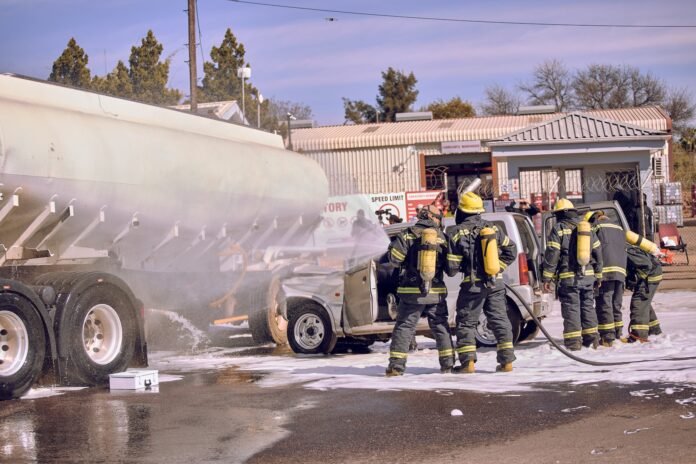


The true value of an emergency plan is revealed not when it is written, but when it is tested. That appears to be the logic behind Vivo Energy Botswana’s latest large-scale simulation exercise, designed to assess how effectively the company and its partners would respond to a serious fuel-transportation incident.
The exercise recreated a complex scenario: two fuel tankers involved in a road accident on Haile Selassie Road in Gaborone, resulting in a major fuel spill and a secondary collision with another vehicle. The objective was to replicate the sort of high-pressure event that demands rapid decisions, clear communication and close coordination among multiple agencies.
Vivo Energy conducted the exercise alongside Botswana Oil Limited and Puma Energy, with support from the police, fire services, ambulance personnel and local authorities. The simulation tested emergency procedures, communication systems and incident-management protocols while assessing how effectively organisations could work together under pressure.
No simulation can perfectly replicate reality. Yet rehearsals often reveal shortcomings that remain invisible in planning documents. Vivo Energy says lessons from the exercise will be incorporated into its continuous improvement programme as it seeks to strengthen operational resilience and emergency-management systems.
For companies operating in sectors where accidents can carry significant economic, environmental and reputational costs, such exercises are less a public-relations exercise than a risk-management necessity. Vivo Energy’s management framed the simulation as part of a broader commitment to maintaining high safety standards and ensuring readiness for real-world emergencies.
The exercise also provided an opportunity to evaluate existing emergency plans, review communication systems and identify weaknesses before they emerge during an actual incident.
No simulation can perfectly replicate reality. Yet rehearsals often reveal shortcomings that remain invisible in planning documents. Vivo Energy says lessons from the exercise will be incorporated into its continuous improvement programme as it seeks to strengthen operational resilience and emergency-management systems.
In industries where safety failures can have serious consequences, preparedness is rarely achieved through policy manuals alone. It is built through repeated testing, institutional memory and coordination across organisations. Vivo Energy’s exercise was, above all, an acknowledgement of that reality.


