


The government and mining executives are betting that the country’s next mining boom will be built not only on copper deposits, but on a new generation of technically skilled workers.
That was the central message at the signing of a Memorandum of Agreement between MMG Khoemacau and the Ministry of Higher Education to establish a Centre of Mining Excellence, a project that government says could reshape the country’s mining workforce and support the rapid growth of copper mining.
The agreement comes at a pivotal moment for the mining sector. Minerals and Energy Minister Bogolo Joy Kenewendo said the country is undergoing a profound transition as copper emerges as a major economic force alongside diamonds.
Maele argued that the true legacy of mining should not be measured by tonnes extracted from the ground, but by the engineers, technicians, entrepreneurs and innovators produced along the way. “Let the deepest legacy of mining be not only what we removed from the ground, but what we planted in the minds of our children,” he said.
“As we experience a crippling downturn in the diamond industry, the hitherto mainstay of our economy, we are also witnessing the emergence of a new giant in the form of base metals, more specifically copper,” Kenewendo said. She pointed to the expansion of the Kalahari Copper Belt and the growth of mechanised underground mining operations as evidence of a changing industry.
Yet the transformation has exposed a growing challenge that Botswana does not currently have enough workers trained for the highly specialised jobs being created by modern underground mines.
According to Kenewendo, the rise of mechanized mining and the copper sector has created a mismatch between the skills produced by technical institutions and the needs of industry. The Centre of Mining Excellence is intended to close that gap by training thousands of young Batswana for careers in the sector.
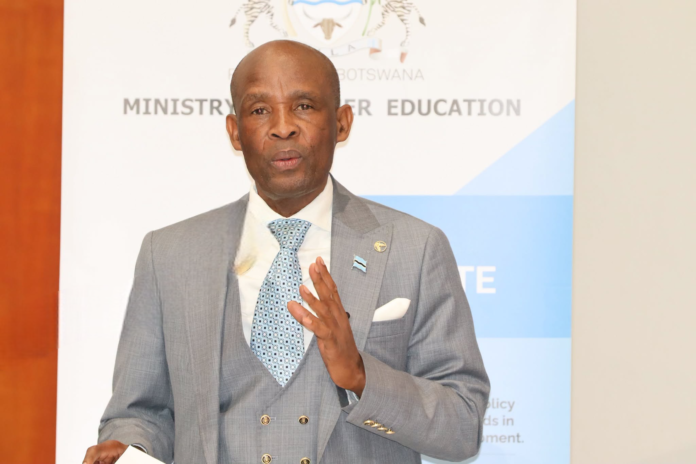
For Higher Education Minister Prince Maele, the project represents a change in how Botswana thinks about education and economic development.
“Our mineral wealth must do more than fuel economic growth. It must help unlock human capital,” he said, arguing that the value of mining should increasingly be measured by the skills, technologies and opportunities it creates rather than simply by production figures. Maele described the agreement as a model for linking education directly to industry needs, saying government, mining companies and educational institutions can no longer operate in isolation if Botswana hopes to remain competitive in a rapidly changing global economy.
The centre, expected to be anchored in Maun, will form part of the government’s wider effort to reposition Technical and Vocational Education and Training (TVET) as a first-choice pathway into employment and entrepreneurship rather than a secondary option.

China MinMetals Corporation chairman Chen Dexin, whose company is the majority investor behind MMG Khoemacau, framed the project as both an investment in Botswana’s future and a symbol of deepening economic ties between Botswana and China.
Chen said the Centre of Mining Excellence would provide world-class technical and vocational training, particularly in underground and mechanised mining, while bringing together government, industry, academia and development partners to ensure the benefits of mining are broadly shared.
The initiative also reflects Botswana’s growing importance in China’s African mining strategy.
Chen described the project as part of a broader commitment to support Botswana’s economic development and deepen bilateral cooperation that has evolved over more than five decades.
Beyond the speeches and ceremony, the significance of the agreement lies in what it reveals about Botswana’s economic future. As diamond revenues become less certain, policymakers are increasingly looking to copper, critical minerals and advanced mining technologies to sustain growth.
But unlike previous mining booms, officials are keen to ensure the benefits extend beyond export earnings.
Maele argued that the true legacy of mining should not be measured by tonnes extracted from the ground, but by the engineers, technicians, entrepreneurs and innovators produced along the way. “Let the deepest legacy of mining be not only what we removed from the ground, but what we planted in the minds of our children,” he said.


