
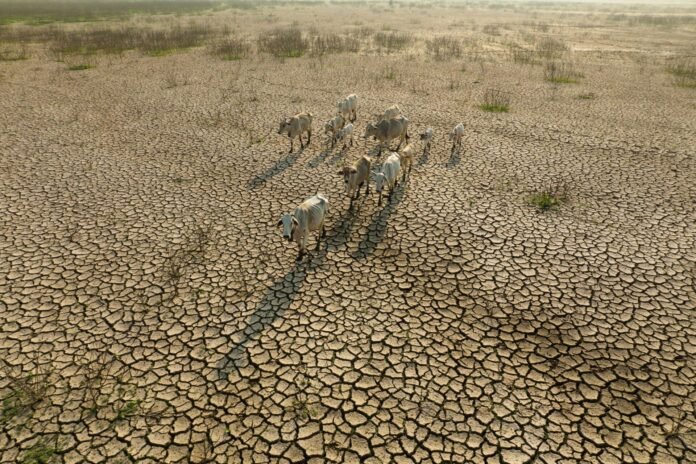


Botswana’s agricultural sector is at the frontline of extreme climate variability. Characterized by semi-arid conditions, rainfed agriculture and livestock remain exceptionally fragile to rainfall anomalies and extreme temperatures. As regional climate dynamics point towards an upcoming El-Niño cycle (October 2026 – March 2027), understanding the broad agricultural impacts is imperative. This report provides a quantitative stress-test of Botswana’s agricultural economy under the anticipated climate shocks. It forecasts the cascading effects of extreme temperatures and rainfall contraction across cereal crop yields and livestock.
Assuming a 5% increase in average temperature and a 25% drop in rainfall, Botswana’s national climate indicators during the El-Niño cycle are projected to reach 31.64°C and 24.69 mm, respectively. In practical terms, these figures signify two critical compounding risks across the country: 1.For the Local Farmer – sustained temperatures above 31.6°C combined with rainfall dropping below 25 mm severely accelerate soil moisture evaporation. Dryland crops (like sorghum and maize) face critical moisture deficits, leading to higher crop failure rates. For pastoralists, higher heat stress combined with poor pasture regeneration will cause livestock weight loss, lower milk yields and elevated mortality.
For Agribusinesses & Commercial Importers – a drop in domestic crop yields forces grain processors, millers, and livestock feed manufacturers to rely almost entirely on regional and international markets.
For Agribusinesses & Commercial Importers – a drop in domestic crop yields forces grain processors, millers, and livestock feed manufacturers to rely almost entirely on regional and international markets. Sourcing grain externally during a regional drought cycle will increase procurement and transport costs, placing upward pressure on operating overheads.
For the Everyday Motswana- lower production matched with an increased national import burden translates into food price increases at retail level. Households will face higher costs for essential food staples like maize meal and sorghum, thus reducing purchasing power.
ARABLE CROP PRODUCTION & FOOD SECURITY
Agricultural statistics indicate a structural divergence in Botswana’s crop sector. The country is historically self-sufficient in sorghum and millet, producing enough to meet domestic demand under normal weather conditions. Conversely, local production of major cereal staples (maize and wheat) falls significantly short of domestic consumption, leaving the nation heavily import-dependent. All volume figures are measured in Metric Tonnes (MT).
The findings demonstrate that the upcoming El-Niño period will extend far beyond an environmental weather event. Evolving into a potential economic and food crisis driven by (1)shortfalls and escalating food prices and (2) fiscal pressure and import requirements. Figures are in metric tonnes (MT).
As local production contracts sharply (sorghum dropping by 12,325 MT and maize falling to just 5,650 MT), local market supply will be severely restricted. For the average Motswana household, reduced local supply means food prices will be higher as traditional staples like sorghum meal and maize meal will become significantly more expensive. Because households and small-scale farmers will lose both their subsistence harvests and incomes simultaneously, higher food prices will disproportionately strain low-income budgets. ❖ For import-dependent staples, the government and other importers face an import burden. Total national imports for maize and wheat are projected to expand to 214,350 MT and 126,843.09 MT respectively, pushing import dependency past 97% for both commodities. Furthermore, traditional self-sufficient crops can no longer cushion the country. Botswana will need to import over 14,500 MT of sorghum to meet basic demand, driving its import dependency from 7.30% up to 47.63%. ❖ Sourcing these foreign grains during a regional El-Niño drought where neighbouring trade partners may implement export restrictions or raise tariff, exposes Botswana directly to international price spikes and supply chain bottlenecks. Grain reserves and emergency procurement plans must be activated early to mitigate this shock.
LIVESTOCK MORTALITY
Cattle mortality spikes in El-Niño conditions; this suggests that cattle are the most vulnerable during these periods. Because cattle are the indicator species for drought impact, we use cattle mortality as the main metric for El-Niño vulnerability in the agricultural livestock sector.
Under a moderate El Niño shock, livestock losses are estimated at P891.73 million. In the worst-case scenario, herd mortality reaches P1.17 billion, representing a severe contraction in agricultural capital that threatens small holder farmers, pastoral income and national meat production capacity.
Under a Severe El Niño event, projected national losses rise to 195,359 cattle. Representing an additional 46,736 and 93,473 cattle deaths above the 2019 baseline, respectively. Unmitigated, this potential loss of up to 195,359 head emphasizes the critical need for targeted supplementary feeding programs, borehole rehabilitation and early destocking incentives prior to the onset of seasonal rainfall deficits.
Under a moderate El Niño shock, livestock losses are estimated at P891.73 million. In the worst-case scenario, herd mortality reaches P1.17 billion, representing a severe contraction in agricultural capital that threatens small holder farmers, pastoral income and national meat production capacity.
The findings of this assessment confirm that the upcoming El-Niño period presents a dual-front economic shock to Botswana, transcending weather anomalies to threaten macroeconomic stability, trade balance and livelihoods: With an estimated 43.5% yield loss across major cereals, sorghum production will drop to 16,008.33 MT and maize to just 5,650 metric tonnes (MT). Crucially, historical buffers will fail. Sorghum’s Import Dependency Ratio (IDR) will increase from 7.30% to 47.63%, while maize and wheat import reliance will rise to 97% and 98%, respectively. Sourcing an additional 14,500 MT of sorghum and over 214,000 MT of maize during a regional drought cycle will expose the domestic economy to foreign price increases and supply bottlenecks. Cattle represent the core store of value for Botswana’s rural economy. Under a moderate El-Niño, national cattle deaths are projected at 148,622 (15.9% mortality), escalating to 195,359 (20.9% mortality) in a severe event. This translates to capital losses between BWP 891.73 million and BWP 1.17 billion, stripping purchasing power from smallholder farmers and severely damaging agricultural wealth. Recommendations To prevent this projected climate shock from evolving into a crisis, the following targeted interventions must be prioritized:
Forward contracts should be initiated for white maize and sorghum before changes take effect across Southern Africa.
The Ministry of Agriculture should introduce early destocking incentives for pastoralists prior to October 2026, paired with targeted subsidies for supplementary feed, lick blocks and borehole rehabilitation in highly vulnerabile communal grazing areas.
Target food assistance and income support programs towards households which rely on rainfed farming, to absorb price shocks on essential staples (maize and sorghum).
Accelerate investments in climate-smart agricultural tech, drought-tolerant grain seed varieties, micro-irrigation systems and climate risk insurance to decouple national food security from weather volatility.


