

Banana Club successfully convened the second edition of its Economic Inclusion Forum on 16 October 2026 at Hilton Garden Inn, Gaborone, bringing together cultural practitioners, entrepreneurs, business leaders and advocates from across sub-Saharan Africa for a day of critical dialogue, knowledge exchange and creative engagement.
Held under the theme Access: Beyond Inclusion, the Forum examined the structural barriers that continue to limit economic participation, particularly for historically marginalised communities, while exploring opportunities across creative industries, entrepreneurship, finance and digital innovation.
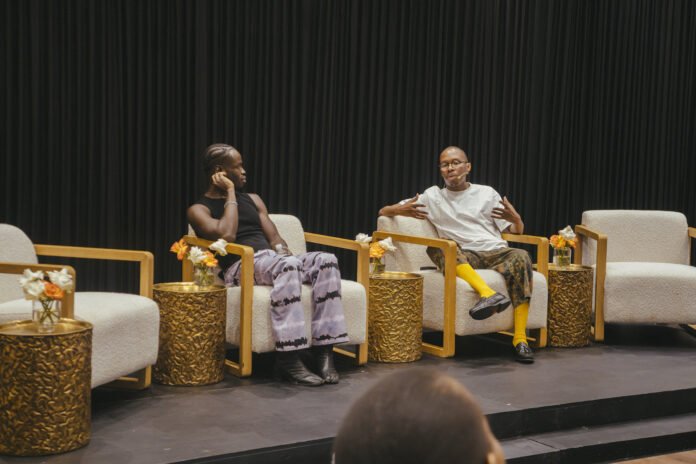
The programme opened with Culture as Economic Power, a conversation between internationally acclaimed creative director IB Kamara and Banana Club Founder and Creative Director Tanlume Enyatseng.
Kamara, whose career has included leadership roles at Dazed and Off-White, reflected on identity, creative ownership and the importance of building opportunities for African creatives beyond traditional centres of cultural influence.
First established in 2025, the Banana Club Economic Inclusion Forum forms part of the organisation’s broader commitment to advancing economic inclusion, artistic development and public discourse in Botswana.
“It is extremely boring to be the only black person in a space,” Kamara remarked, challenging the notion that individual representation constitutes meaningful progress. His reflections emphasised the importance of collective advancement, arguing that success should be measured not simply by individual recognition, but by the ability to create opportunities and economic security for others. Kamara also encouraged African creatives to recognise the possibilities of building internationally relevant careers from their home countries, noting that digital connectivity has transformed how creative work reaches audiences and markets.
The conversation established a central proposition that resonated throughout the Forum: cultural influence must translate into economic opportunity, ownership and sustainable livelihoods.
From representation to meaningful participation
The Forum continued with three panel discussions examining different dimensions of economic inclusion.
Access to Opportunity brought together Chris Muriithi of QACC Africa, and Mino Likwasi of Women’s Alliance for Equality, moderated by Rorisang Mogojwe. The discussion explored barriers to economic participation, inclusive entrepreneurship and the institutional conditions necessary to create meaningful opportunities for underserved communities.
Access to Capital, featuring Lipian Bongani Mtandabari, Thiruna Naidoo and Karabo Letsholo, moderated by Seanokeng Phuthego, examined the challenges facing small businesses and entrepreneurs in accessing financial resources. The conversation also highlighted the importance of financial literacy, healthier relationships with money and sustainable business practices.
The final panel, Access to Digital Futures, featured Dato Seiko, Eliana N’Zualo and Ban-T, moderated by MamThug. The discussion considered the expanding role of digital platforms, technology and music in shaping Africa’s creative economy, and the importance of ensuring that creators benefit economically from the cultural value they generate.
The final panel, Access to Digital Futures, featured Dato Seiko, Eliana N’Zualo and Ban-T, moderated by MamThug. The discussion considered the expanding role of digital platforms, technology and music in shaping Africa’s creative economy, and the importance of ensuring that creators benefit economically from the cultural value they generate.
Extending dialogue into practice
Beyond the formal discussions, the Forum incorporated practical skills development and creative engagement through the Digital Futures Lab.
The afternoon programme featured a DJ skills workshop facilitated by Thuli Tools, alongside the Makwati Media Lounge, which provided a space for creative industry engagement.
The day concluded with Open Decks, curated by MamThug, creating a platform for emerging DJs and extending the Forum’s conversations into an accessible celebration of music, community and creative expression.
Together, these activities reflected Banana Club’s commitment to connecting critical dialogue with practical opportunities for learning, participation and cultural production.
Building more equitable creative economies
First established in 2025, the Banana Club Economic Inclusion Forum forms part of the organisation’s broader commitment to advancing economic inclusion, artistic development and public discourse in Botswana.
The inaugural Forum introduced the concept of the Pink Pula, a framework for examining queer economic participation and the economic potential of historically underserved communities within Botswana’s cultural and creative industries.
Building on that foundation, the 2026 edition broadened the conversation to consider how cultural influence, institutional partnerships, financial access and digital innovation can contribute to more equitable and sustainable economic ecosystems.


