
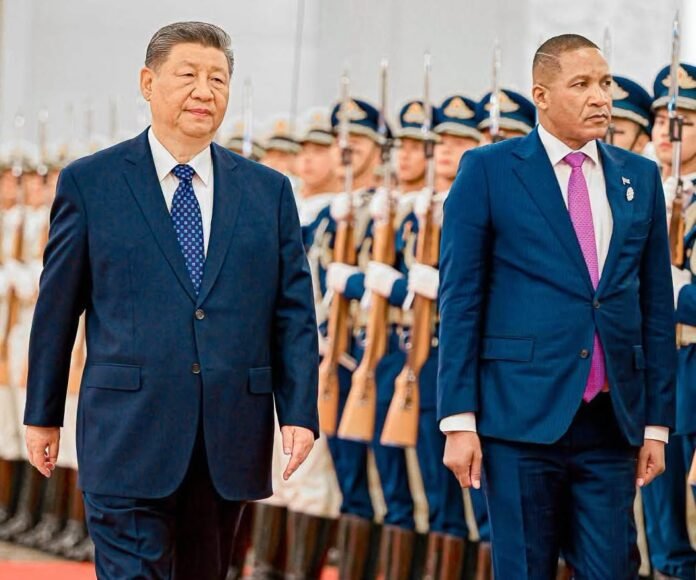


President Duma Boko’s recent visit to China to court President Xi Jinping and deepen diplomatic and economic relations comes against the backdrop of growing public disillusionment with Beijing, with a new Afrobarometer survey revealing that the proportion of Batswana who view Chinese influence positively has almost halved over the past decade.
The findings reveal a widening gap between the government’s diplomatic courtship of China and public perceptions of the Asian economic powerhouse, whose influence in Botswana is increasingly viewed with less enthusiasm than it was a decade ago.
According to the survey, the proportion of Batswana who consider China’s economic and political influence on the country positive has plunged from 74 percent in 2014 to just 37 percent in 2024, representing a 37-percentage-point decline. The latest findings suggest that Beijing’s longstanding diplomatic relations and considerable economic footprint in Botswana have not translated into sustained public confidence in its influence. Afrobarometer reports that only half of Batswana (50 percent) believe China’s economic activities have some or a lot of influence on the country’s economy, down sharply from 76 percent in 2014.
It further observes that “the proportion of citizens who see China’s influence on Botswana as substantial has declined sharply compared to a decade ago (from 76% to 50%), as has the share who see China’s influence as positive (from 74% to 37%).”
The decline comes despite China’s growing position as a major development and economic partner across Africa, raising questions about whether its economic engagement is generating the same public goodwill it enjoyed in the past.
The report states: “Notably, perceptions of China’s influence on Botswana as substantial and positive have declined sharply over the past decade.”
It further observes that “the proportion of citizens who see China’s influence on Botswana as substantial has declined sharply compared to a decade ago (from 76% to 50%), as has the share who see China’s influence as positive (from 74% to 37%).”
The survey also reveals significant differences in how various sections of society perceive China’s involvement in Botswana, suggesting that public attitudes are shaped partly by education, economic circumstances and geographical location.
Men and urban residents are more likely than women and people living in peri-urban and rural communities to regard Chinese influence as substantial and beneficial.
Education appears to be a particularly important dividing factor with respondents who have higher levels of education twice as likely as those with primary education or no formal schooling to consider China’s influence significant. Among highly educated respondents, 67 percent regard Chinese influence as substantial, compared with 33 percent among those with primary education or no formal schooling.
Despite the declining public assessment of China’s broader economic and political influence, Beijing retains some goodwill among Batswana for its contribution during the COVID-19 pandemic.
The gap is similarly pronounced when respondents are asked whether China’s influence is beneficial. Half of those with higher education consider it positive, compared with just 23 percent among respondents with primary education or no formal schooling.
Economic standing also appears to influence perceptions of Beijing with 43 percent of economically better-off citizens viewing China’s impact on Botswana positively, compared with between 32 and 34 percent among poorer respondents.
Despite the declining public assessment of China’s broader economic and political influence, Beijing retains some goodwill among Batswana for its contribution during the COVID-19 pandemic.
Asked which countries or organisations were most helpful to Botswana during the pandemic, 46 percent identified China, making it the most frequently mentioned contributor.
The United States came a distant second at 10 percent, followed by the African Union and Africa Centres for Disease Control and Prevention at five percent. However, 35 percent of respondents said they were uncertain about which country or organisation had been Botswana’s biggest benefactor.


