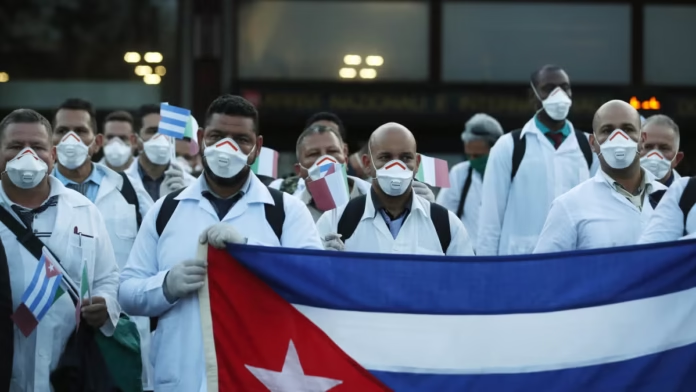


President Duma Boko’s government has been plunged into a potentially diplomatic and human-rights scandal. This is after an international human-rights organisation accused Botswana of financially sustaining what it describes as a system of “modern slavery” involving Cuban doctors working in the country.
In a report released this week, Prisoners Defenders alleges that Botswana pays substantially more for Cuban medical specialists than the doctors themselves receive while Cuban authorities retain control over their remuneration and impose restrictions on their movement, social lives and personal freedoms.
The organisation is now demanding that the Boko administration explain what it knew about the alleged arrangements and whether Botswana authorised or tolerated disciplinary rules imposed by the Cuban medical mission on its territory. Prisoners Defenders says Botswana entered into an agreement with Cuba in 2024 under which the country pays €3,500 per month for each Cuban medical specialist, equivalent to about US$4,095 at the exchange rate cited in the report. Yet, according to information obtained by the organisation, Cuban specialists receive only US$1,000 a month.
It further alleges that Botswana has therefore not merely been an innocent recipient of Cuban medical services, but has financially supported a system whose labour practices have previously attracted international trafficking concerns.
The organisation estimates that Botswana’s annual bill for about 90 Cuban medical professionals exceeds US$4.2 million.
The allegations are damaging because they raise questions over whether public money paid by Botswana for medical services is being used to finance a system in which Cuban professionals allegedly receive only a fraction of the amount paid for their services. Prisoners Defenders claims that the Botswana-Cuba agreement itself separates the amounts intended for professionals from money transferred to Cuba.
It further alleges that Botswana has therefore not merely been an innocent recipient of Cuban medical services, but has financially supported a system whose labour practices have previously attracted international trafficking concerns.
The 2025 US Trafficking in Persons Report specifically warned that the Cuban regime “may have forced approximately 80 Cuban regime-affiliated medical professionals in Botswana to work” and recommended that Botswana systematically screen Cuban medical workers for trafficking indicators.
That warning did not emerge in isolation. Previous US trafficking reports have repeatedly identified Cuban medical personnel in Botswana as a potentially vulnerable group. The 2024 report recommended that Botswana proactively identify trafficking victims among Cuban government-affiliated medical professionals. The latest allegations, however, add a new a dimension: an internal order allegedly issued on 3 July 2026 by the head of the Cuban medical mission in Botswana, Dr Pablo Ricardo Betancourt Álvarez.
According to Prisoners Defenders, the order restricts Cuban doctors from leaving their assigned districts except for professional or health reasons without prior consultation with Cuban mission leadership. It allegedly also prohibits visitors from staying overnight in doctors’ assigned accommodation, restricts doctors from spending nights outside their assigned homes, bars them from visiting Cuban residents outside the medical brigade and prohibits participation in activities not officially organised by the Cuban mission.
The order reportedly goes further by restricting doctors from acquiring or driving motor vehicles without express authorisation and placing restrictions on late-night outings.
Prisoners Defenders says violations can trigger disciplinary measures under the Cuban mission’s internal regulations. The organisation argues that the issue is no longer simply about the terms of a bilateral medical cooperation agreement, but whether foreign authorities are exercising coercive control over workers inside Botswana. The report says testimonies collected in Botswana described restrictions on accommodation and movement, fear of surveillance and concerns about reprisals. It also claims some doctors worked between 56 and 64 hours a week, with an average of 57.6 hours. The allegations put the Boko administration in a difficult position because the government must now explain whether it knew about the alleged restrictions and, if so, what action it took. Prisoners Defenders has posed a series of direct questions to the government. Among them is whether the Ministries of Health and Finance knew about alleged salary retention, passport withdrawal and the disciplinary regime. It also wants Botswana to explain whether it knew about or authorised the July 3 order and whether officials have checked how the alleged restrictions are being implemented in doctors’ homes and districts.
The US government has for years raised concerns over Cuba’s international medical missions. Its trafficking reports have described coercive practices associated with Cuba’s labour-export programme, including pressure to remain in missions and punishment for workers who leave. Therefore, for the new Botswana government, the scandal is no longer simply about Cuban doctors.
The organisation is also demanding information on how many Cuban professionals have sought to terminate their missions, been replaced, repatriated or declared “deserters”. It asks why Cuban doctors do not have an independent and confidential complaints mechanism outside the control of Cuban mission leadership. Prisoners Defenders is calling on Boko’s government to publish the full Botswana-Cuba agreement, all addenda, budget authorisations, invoices and payments, while protecting legitimate personal information.
It also wants Cuban doctors to be paid directly for the full amount corresponding to their work, with only ordinary and transparent taxes deducted. The organisation is further demanding individual interviews with Cuban medical workers without Cuban coordinators present, independent legal assistance, retention of passports and credentials, freedom of movement and protection from retaliation. It wants Botswana to suspend and investigate the implementation of the July 3 order and establish an independent grievance mechanism involving labour inspection and technical cooperation from the International Labour Organization.
The controversy is uncomfortable for the Boko administration because the agreement predates its tenure. But Prisoners Defenders argues that the current government is now responsible for the administration and enforcement of arrangements operating on Botswana soil.
The US government has for years raised concerns over Cuba’s international medical missions. Its trafficking reports have described coercive practices associated with Cuba’s labour-export programme, including pressure to remain in missions and punishment for workers who leave. Therefore, for the new Botswana government, the scandal is no longer simply about Cuban doctors.
It is about whether Botswana is knowingly paying into a system accused internationally of forced labour and whether its own institutions have turned a blind eye to what happens to those workers once they arrive in the country. The government now faces a straightforward question: what did it know, when did it know it and what will it do about it?