
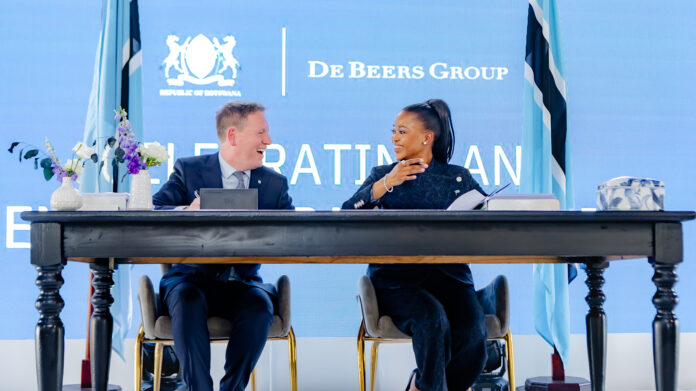

Botswana is faced with a high-stakes decision over whether to increase its shareholding in De Beers as Anglo American moves to sell its 85% stake with the latest Econsult Economic Review for 2025 warning that the financial and strategic case for a major acquisition remains weak.
Anglo American, which owns 85% of De Beers, is seeking to dispose of the asset as part of a broader corporate rationalisation and restructuring drive. The remaining 15% is held by the Government of Botswana (GoB), which has the right of first refusal should Anglo proceed with the sale. However, the process has been protracted, reflecting several complications, including the fragile state of the global natural diamond market, sustained losses at De Beers, and uncertainty over Botswana’s own intentions.
According to Econsult, Anglo would prefer a direct sale to new owners rather than a public listing on a major stock exchange. While GoB has publicly indicated interest in buying, it has not clarified whether this would involve a marginal increase in its stake, the acquisition of a controlling interest (35% plus one share), or a full buy-out of Anglo’s holding.
Econsult notes that determining the best approach from Botswana’s perspective has generated sharply divided views both domestically and internationally. The International Monetary Fund (IMF) has already advised against Botswana increasing its stake in De Beers, citing the country’s precarious fiscal position and its already heavy dependence on diamonds.
The economic review outlines several critical considerations. First, any transaction should prioritise the revival and restructuring of De Beers to address structural challenges in the global natural diamond industry, including weak demand and competition from lab-grown stones. This raises the question of which ownership structure would be best placed to deliver such a turnaround.
Second, Econsult stresses that Botswana is financially constrained and lacks the resources to fund a major share purchase from its own balance sheet. Borrowing to finance an acquisition would amount to a leveraged buy-out, which the review describes as both difficult and risky given existing debt pressures.
Finally, the review underscores that Botswana’s overriding economic challenge remains diversification away from diamonds. Increasing exposure to De Beers, a company primarily anchored in mining, risks reinforcing rather than reducing this dependence.
Third, the consultancy highlights that Botswana already enjoys substantial exposure to De Beers. Beyond its direct 15% shareholding, GoB holds a 50% stake in Debswana, De Beers’ flagship mining operation, giving it an estimated 50% effective economic interest in the group. On this basis, Econsult argues that the financial benefits of buying additional shares have not been clearly demonstrated.
Finally, the review underscores that Botswana’s overriding economic challenge remains diversification away from diamonds. Increasing exposure to De Beers, a company primarily anchored in mining, risks reinforcing rather than reducing this dependence.
Econsult’s valuation breakdown shows mining operations account for 70–75% of De Beers’ value, followed by Element Six at 15–20%, with exploration and trading contributing smaller shares. Given this structure, the consultancy suggests Botswana’s interests may be better served by helping to assemble a broad ownership coalition rather than pursuing outright control.
Such a coalition could include producing-country governments, mining expertise, luxury goods marketing specialists and well-capitalised financiers to share risks and funding needs. Econsult concludes that raising Botswana’s stake modestly to around 26%, securing a blocking minority, could protect national interests without exposing the country to excessive financial and business risk.


