

Botswana’s decision to accept military aircraft from the United States has become the latest flashpoint in regional politics after the Botswana Defence Force (BDF) defended the donation days before Economic Freedom Fighters (EFF) leader Julius Malema publicly urged the country to reject American military assistance.
The controversy, which began with questions over the cost of maintaining the donated aircraft, has now evolved into a debate over Botswana’s defence partnerships and its foreign policy orientation. This follows Malema’s criticism of the arrangement while addressing delegates at the Botswana National Front’s (BNF) National Conference 2026.
Earlier this week, the BDF dismissed reports suggesting that the recently donated C-130 Hercules transport aircraft could become a financial burden for Botswana, describing such claims as “misleading, speculative and devoid of factual foundation.”
The military said the aircraft was transferred through the United States government’s Excess Defence Articles (EDA) Programme, an established security cooperation initiative that enables partner countries to acquire surplus but serviceable military equipment.
“It is therefore misleading to portray Botswana’s participation in this programme as an extraordinary arrangement with hidden obligations,” the BDF said.
“The BDF can assure the nation that it has thoroughly inspected the aircraft, confirming it is fully operational and mechanically sound … There are no underlying or undisclosed conditions,” the statement said. It argued that receiving the aircraft through the programme strengthened Botswana’s airlift capability while sparing taxpayers the cost of purchasing similar equipment.
According to the military, the programme operates within established bilateral agreements based on shared security interests and has benefited several countries across Africa and beyond.
The BDF also rejected suggestions that Botswana had inherited hidden financial liabilities.
“Like every modern defence force, the BDF conducts technical, operational and financial assessments prior to acceptance of any military equipment,” it said.
Seeking to reinforce the value of the partnership, the BDF said the United States donated almost P13 million worth of new C-130 maintenance parts in January 2026 and has since approved Botswana to receive two additional C-130H aircraft under the same programme.
“The BDF can assure the nation that it has thoroughly inspected the aircraft, confirming it is fully operational and mechanically sound … There are no underlying or undisclosed conditions,” the statement said. It argued that receiving the aircraft through the programme strengthened Botswana’s airlift capability while sparing taxpayers the cost of purchasing similar equipment.
But the issue took on a distinctly political dimension three days later when Malema used the BNF conference platform to denounce Botswana’s military relationship with Washington.
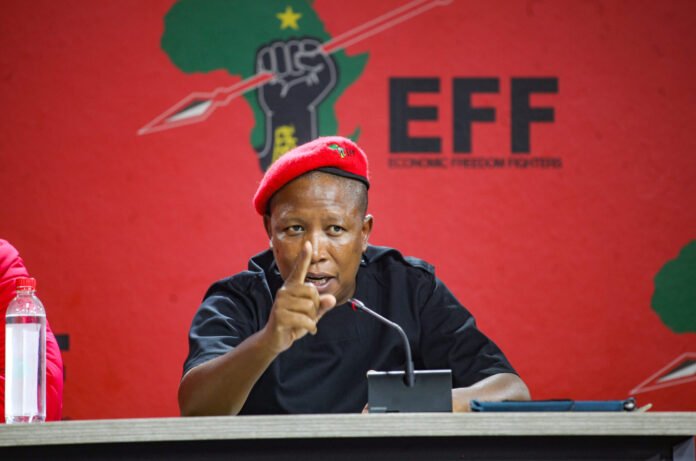
Addressing delegates at the ruling coalition partner’s gathering, Malema urged Botswana to reject American military donations, arguing that the aircraft were allegedly linked to US involvement in Palestine and its longstanding policies towards Cuba. Botswana, he said, should not accept aircraft “stained with the blood of innocent people.” He also dismissed the strategic value of closer ties with Washington. “America has never been, and will never be, Botswana’s friend,” Malema declared.


