
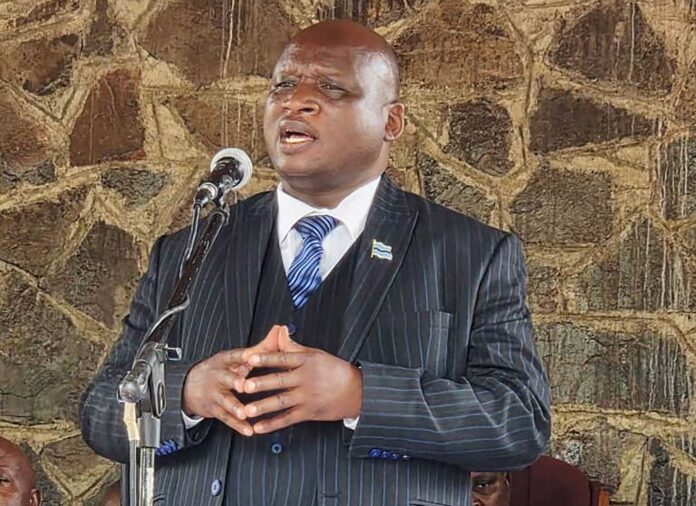


Member of Parliament for Palapye, Onneetse Ramogapi, has taken his constitutional court outreach to local kgotla meetings, where he explained the proposed Constitutional Court, its role in Botswana’s democracy, and concerns raised around government priorities.
He said the court is essential to Botswana’s constitutional democracy because it upholds the rule of law, protects fundamental human rights, and ensures that laws and actions taken by the executive and legislature comply with the Constitution, which is the supreme law of the land.
According to Ramogapi, the Constitutional Court would strengthen democracy by serving as an independent referee in constitutional disputes. He noted that it would enhance accountability in government, protect minority and vulnerable groups, and provide a forum where constitutional justice can be accessed more directly, especially in urgent cases involving rights and freedoms.
He outlined several key reasons why a Constitutional Court is important for Botswana. These include judicial review powers to test laws and policies against the Constitution and declare them invalid if they are unconstitutional; protection of citizens’ rights and freedoms against arbitrary state action; and a central role in resolving electoral disputes and checking executive power. He added that the court would ensure government institutions remain accountable to the Constitution and would act as a guardian for minority communities, including groups whose voices are often marginalised.
Beyond legal issues, Ramogapi said the establishment of the Constitutional Court would contribute to job creation. During the construction phase, he noted, employment opportunities would arise for professionals such as architects, quantity surveyors, engineers, project managers, and consultants, as well as artisans including bricklayers, electricians, plumbers, carpenters, tilers, painters, and safety officers.
Ramogapi also explained the specific functions of the Constitutional Court as proposed in the bill before Parliament. These include being the final authority on all constitutional matters, with decisions that bind all other courts; deciding whether a case qualifies as a constitutional matter; and exercising original and final jurisdiction over cases involving the enforcement of fundamental rights under sections 3 to 16 of the Constitution.
The court would also have powers to determine disputes over membership of the National Assembly, rule on the constitutional status and powers of entities, and make final decisions on whether Acts of Parliament are constitutional. In cases where the High Court declares a law unconstitutional, the Constitutional Court would be required to confirm such rulings before they take effect. The court may also hear appeals on matters of general public importance involving points of law.
Beyond legal issues, Ramogapi said the establishment of the Constitutional Court would contribute to job creation. During the construction phase, he noted, employment opportunities would arise for professionals such as architects, quantity surveyors, engineers, project managers, and consultants, as well as artisans including bricklayers, electricians, plumbers, carpenters, tilers, painters, and safety officers.
Once operational, the court is expected to employ 11 judges, their secretaries, a registrar and deputy registrar, as well as support staff such as receptionists, cleaners, gardeners, security personnel, maintenance crews, and occupational health and safety officers.
Responding to concerns raised by some residents about prioritising the Constitutional Court over access to medicines, Ramogapi relayed the government’s position that medicine shortages have been a long-standing challenge predating the current administration. He said government operations require balancing multiple priorities, adding that essential services such as roads, water supply, and responses to crises like foot-and-mouth disease cannot be halted to fund a single sector.
He explained that each ministry plans and manages its own budget, with provisions in place to assist during emergencies, stressing that the establishment of the Constitutional Court does not mean the government is neglecting other critical needs.
Ramogapi said the kgotla engagements were meant to ensure that communities understand the proposed court and its implications, encouraging informed public discussion on constitutional reforms.


