
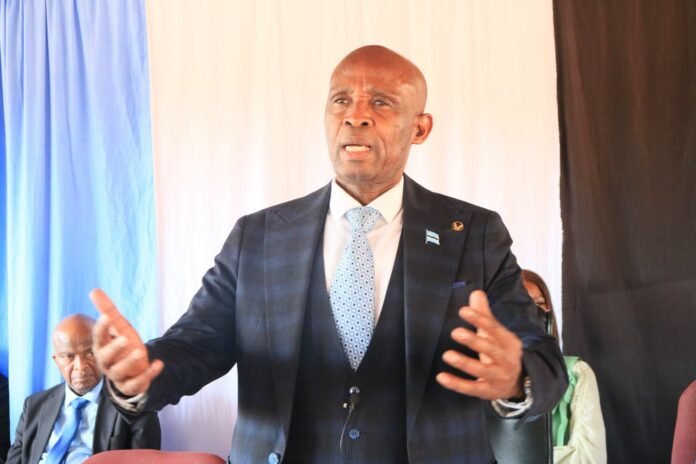


Prince Maele’s brief and unexpected exit from the Office of the ‘Acting’ President has exposed confusion within government over Vice-President Ndaba Gaolathe’s travel movements.
Having publicly thanked President Duma Boko for appointing him Acting President from September 18 to September 26, Maele appeared to expect a full week in the role.
Instead, his tenure was abruptly cut short when Gaolathe quietly returned to the country just two days into his Acting role, leaving the Minister embarrassed after publicly announcing dates that events would soon overtake.
The episode has drawn attention to what sources at Government Communications office describe as the Vice-President’s habit of travelling without his movements being widely communicated within government.
The source said Gaolathe’s office does not routinely inform the Government Communications and Information System (GCIS) about his departures or return dates, often leaving officials scrambling to establish his whereabouts.
At the time, President Boko was attending the United Nations General Assembly in New York, while Gaolathe was also abroad. With both men absent, Maele assumed the constitutional responsibilities of Acting President and publicly expressed his gratitude for the opportunity.
His statement, however, quickly became outdated when Gaolathe reappeared and resumed his constitutional duties as Vice-President, automatically ending Maele’s acting presidency earlier than anticipated.
According to a source at Government Gommunications office, such uncertainty is not uncommon. “We never know when he is coming or going,” the source said, referring to the Vice-President’s travels. The source said Gaolathe’s office does not routinely inform the Government Communications and Information System (GCIS) about his departures or return dates, often leaving officials scrambling to establish his whereabouts.

The practice has also created friction between government communicators and journalists. Questions have been raised about the absence of official announcements concerning the Vice-President’s foreign trips, with some reporters accusing GCIS of failing to keep the public informed. Officials familiar with the matter, however, say the communications office is often working with incomplete information itself. The latest incident illustrated how the uncertainty can extend beyond communications officials to ministers occupying acting roles. Maele’s public message suggested an expectation that both the President and Vice-President would remain outside Botswana until September 26. Gaolathe’s unexpected return changed that calculation and shortened the acting arrangement.
The source said the reluctance to publicise the Vice-President’s travel plans stems partly from public criticism of frequent overseas trips at a time when the country faces economic challenges. Gaolathe himself has been the public face of the government’s austerity drive, which includes restrictions on travel and spending across the civil service.


