
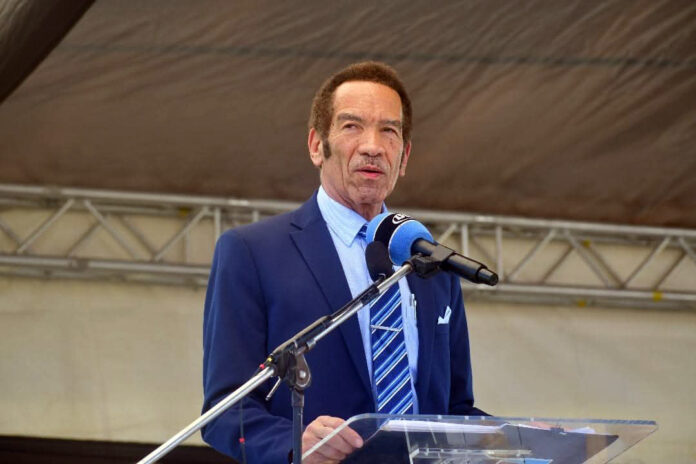

The government has been warned against allowing its diplomatic disagreement with former president Ian Khama over his criticism of Zambian President Hakainde Hichilema to escalate into a public confrontation.
Diplomatic sources who spoke to this publication have advised the Duma Boko administration to engage the former head of state privately.
The sources say government should borrow a leaf from the previous Botswana Democratic Party (BDP)-led administration in handling Khama arguing that his comments should not be dismissed as the political outbursts of a former president who has lost power.
They warned that Khama is no political lightweight and that his interventions carry political and diplomatic weight which government should treat with the seriousness they deserve.
The warning comes amid growing controversy over Khama’s reported description of Hichilema as “Africa’s newest dictator.” The remarks have provoked an angry reaction from Zambia’s ruling United Party for National Development (UPND).
The warning comes amid growing controversy over Khama’s reported description of Hichilema as “Africa’s newest dictator.” The remarks have provoked an angry reaction from Zambia’s ruling United Party for National Development (UPND).
The sources said the diplomatic implications of the remarks should also be considered, particularly given Botswana’s relationship with Zambia and the need to maintain cordial relations with neighbouring countries.
Khama’s intervention has placed the government in an uncomfortable position, forcing it to defend its decision to attend Hichilema’s inauguration while balancing diplomatic protocol against Botswana’s stated commitment to democracy, human rights and the rule of law.
At the centre of the controversy is Khama’s question to Foreign Affairs Minister Dr Phenyo Butale at Ntlo ya Dikgosi.
“With the stated position of Botswana as upholding the rule of law, democracy and human rights, with hindsight, does the Minister regret that we attended the inauguration of Africa’s newest dictator in Zambia, after they have violated all these principles that we uphold?” Khama asked.
Butale defended Botswana’s attendance, arguing that diplomatic engagement with neighbouring countries was necessary to encourage dialogue and influence democratic processes.
The UPND subsequently challenged Khama’s reported description of Hichilema, arguing that Zambia’s democratic record should be judged on evidence, institutions and citizens’ ability to exercise their rights. However, diplomatic sources argue that the government should look beyond the immediate controversy and recognise a broader pattern in Khama’s interventions: he has increasingly used Ntlo ya Dikgosi to demand explanations from the Boko administration on matters touching on public accountability, foreign policy and the exercise of executive power.
His questioning of government over Botswana’s position on the Russia-Ukraine war is one example of why diplomatic sources believe he should not be underestimated.
Khama has also raised questions about the recruitment of Batswana to fight in the Russia-Ukraine conflict as he demanded to know what diplomatic steps government had taken to protect citizens, whether any had died, been injured or captured, and what legal consequences they could face.
His questions continued to generate responses from Butale, including revelations that three Batswana had been injured and another captured by Ukrainian forces.
Another intervention which exposed the administration to questions about transparency involved the appointment of Botswana People’s Party (BPP) president Motlatsi Molapisi as a Presidential Adviser to Boko.
Khama questioned the circumstances under which Molapisi, who already draws a salary from government coffers was appointed to advise President Boko.
Butale, who responded on behalf of Presidential Affairs Minister Moeti Mohwasa, told Ntlo ya Dikgosi that the appointment was made through the President’s prerogative.
Khama, however, was not satisfied with the explanation and challenged the minister as he made it clear that his question was not about whether the President had the constitutional authority to make appointments.
His concern, he argued, was about accountability and transparency surrounding the appointment, including the circumstances under which Molapisi was selected and the justification for the arrangement.
Khama has also questioned the accountability and cost-effectiveness of covert deployments within the Directorate of Intelligence and Security (DIS). He sought to know whether officers operating outside conventional offices were subject to adequate supervision and whether their productivity could be independently assessed.
He further questioned whether the responsible minister had personally seen intelligence reports produced by the officers and whether an independent review should be conducted. Government maintained that the deployments were lawful and supervised under the Intelligence and Security Services Act, but Khama’s intervention brought questions about intelligence oversight and public expenditure into the open.
In May 2022, then president Mokgweetsi Masisi instructed Botswana’s diplomatic envoys that responses to Khama’s criticism should be undertaken with “honour and respect and within the full understanding of the cultural norms and ethos of Botswana”.
The diplomatic sources believe the Boko administration should be careful not to turn its disagreement with Khama into a political contest that could unnecessarily complicate Botswana’s diplomatic standing.
They argue that the previous BDP-led administration, despite its eventual acrimonious relationship with Khama, recognised the importance of responding to a former president with due regard to his status.
In May 2022, then president Mokgweetsi Masisi instructed Botswana’s diplomatic envoys that responses to Khama’s criticism should be undertaken with “honour and respect and within the full understanding of the cultural norms and ethos of Botswana”.
Masisi acknowledged Khama’s status as a former president while insisting that government had a responsibility to respond to some of his utterances.
Although the Masisi-Khama relationship subsequently deteriorated into a bitter political feud, the former administration’s stated emphasis on respectful engagement offers a lesson for the current government.
Asked if the government has engaged him on issues he raised; Khama said; “No they have not.” He added that; “I think that maybe it is because they believe that the answers they give in the house are adequate.’


