


There are meetings that pass quietly through government corridors and disappear into filing cabinets. Then there are meetings that signal something larger, a subtle shift in who gets to sit at the table, whose fears are heard and whose experiences are recognised as part of the national story.
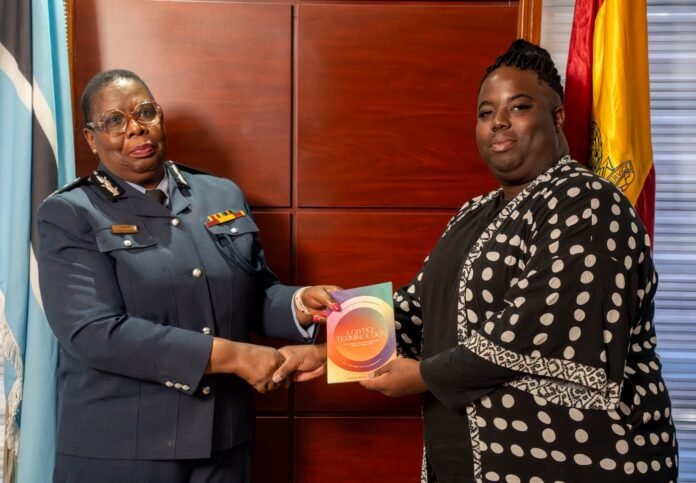
When Success Capital walked into Botswana Police Service (BPS) headquarters to meet Commissioner Dinah Marathe, the organisation was carrying more than a list of concerns. It was carrying years of frustration, reports of violence, unanswered questions and the weight of communities that often feel invisible when conversations about safety and justice are held.
The meeting itself was unprecedented. According to Success Capital, it marked the first time nationally and regionally that the head of a police service had formally met with LGBTIQ+ constituents to explicitly discuss their safety and experiences with law enforcement.
But the significance of the engagement lies in what it revealed about the complicated relationship between vulnerable citizens and the institutions meant to protect them.
For years, Success Capital says its work on safety and security has been driven by growing reports of hate speech, intimidation and violence targeting LGBTIQ+ Batswana. Concerns intensified in 2025 after several individuals with prominent social media profiles allegedly suffered violent attacks in public recreational spaces. One influencer reportedly endured three separate assaults before relocating from Maun. The organisation’s concerns are not only about violence itself but also about what happens after violence occurs. Can victims report safely? Will they be taken seriously? Will investigations proceed without prejudice? And perhaps most importantly, do vulnerable citizens trust the system enough to seek help in the first place?
Those questions formed the backdrop to the meeting.
Success Capital presented findings from community dialogues conducted across Botswana, highlighting instances where transgender people, cisgender women and cisgender men had experienced indignity, disregard or dismissive treatment while engaging police services. At the same time, the organisation acknowledged that escalation mechanisms within the BPS often work when complaints are pursued through higher-ranking structures.
What emerged from the discussion was a portrait of a police leadership eager to project accountability and openness.
Marathe said grievances should be addressed immediately and that officers are expected to uphold professionalism, care and non-discrimination in every interaction. Any officer acting contrary to those values, she said, would be acting outside the standards of the institution.
She also apologised for a recent incident raised during the meeting and reiterated what Success Capital described as a “zero tolerance” approach to misconduct. The Commissioner repeatedly emphasised that the police service belongs to all citizens.
For Success Capital, one of the most notable aspects of the engagement was the Commissioner’s recognition that Botswana’s laws are gender neutral and that assistance should be provided consistently regardless of who seeks help. The discussion also touched on sexual assault against male detainees and the need for such cases to be properly investigated and prosecuted.
“Sepodisi ke sa lona (We are at your service),” she told participants the police are yours.
The phrase carries weight in a country where trust in institutions often depends on personal experience rather than official slogans.
For Success Capital, one of the most notable aspects of the engagement was the Commissioner’s recognition that Botswana’s laws are gender neutral and that assistance should be provided consistently regardless of who seeks help. The discussion also touched on sexual assault against male detainees and the need for such cases to be properly investigated and prosecuted.
Yet the meeting was not merely about reassurance. It also exposed structural realities that complicate policing across Botswana.
Community consultations conducted by Success Capital revealed that some rural police and health posts operate with limited resources, including shortages of vehicles and personnel. In places such as Mabuo, a handful of officers are responsible for vast geographical areas stretching toward the Central Kalahari Game Reserve.
Distance, infrastructure and fear all shape whether justice can be accessed.
Success Capital says some community members are reluctant to report crimes because they fear retaliation or social repercussions. In smaller communities, where anonymity is nearly impossible, reporting violence can come at a personal cost.
The organisation has therefore called for stronger accountability mechanisms, including anonymous reporting channels and independent oversight structures. The proposals are less about bureaucracy than about human behaviour. What happens when the officer receiving a complaint is a neighbour, a relative or someone who already believes that certain people do not belong?
That question surfaced repeatedly in Success Capital’s consultations. In some villages, participants spoke of reporting violence in environments where privacy is scarce and social stigma travels faster than official information. Others described the practical realities of rural policing, where a shortage of vehicles, personnel and resources can turn the simple act of opening a case into a logistical challenge.
Perhaps the most revealing aspect of the meeting was not what was said about policy, but what was said about access. One of the Commissioner’s first observations was that the police service would have arranged a sign language interpreter had they known one was needed. It was a small comment, easily missed among discussions of crime statistics, investigations and accountability. Yet it spoke to a larger truth: inclusion often begins with noticing who is absent from the room.
From Success Capital’s perspective, getting into that room was itself a lesson in persistence. The meeting followed months of requests, delays and eventually the intervention of the Ombudsman before police headquarters reached out. The process was neither quick nor smooth. But it produced something that many community members had been asking for: a chance to speak directly to those who shape the culture of one of Botswana’s most powerful institutions.
Whether the encounter changes life at a police station in Maun, Francistown or a remote village post remains an open question. Meetings do not automatically become policy, and policy does not automatically become practice. Still, there was symbolism in the scene itself. Around one table sat police commanders, activists and citizens whose experiences of the state have often been defined by distance. For a few hours, that distance narrowed. The harder work begins now, long after the photographs are taken and the minutes are filed away.


