


Botswana’s artistic traditions are travelling beyond the country’s borders, finding expression in an international art installation that connects the geological history of natural diamonds with the knowledge and creativity of the people who work with the natural world.
Unveiled at Frieze Masters in London this month, De Beers’ Voyage Through the Diamond Realm, Chapter II: On the Birth of a Diamond explores the journey from the formation of carbon in the earliest stars to the creation of diamonds deep beneath the Earth’s surface, before arriving at the human craft that transforms rough stones into treasured objects.
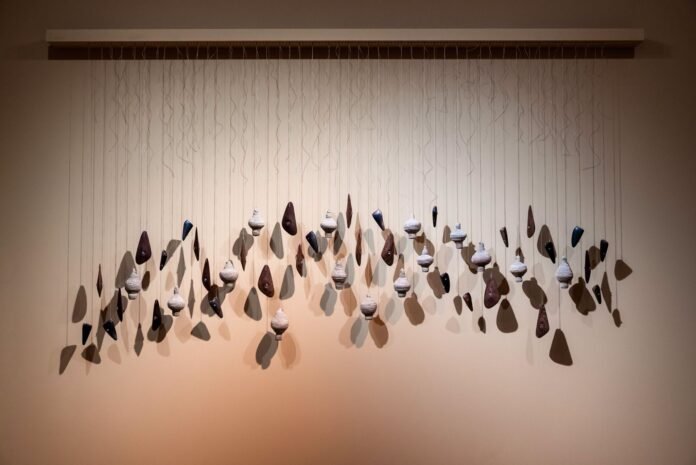
At its centre is a five-metre handcrafted tapestry by Shifron Mercury Studio, made using natural fibres from Botswana’s Okavango Delta. Ceramic fragments inspired by rough diamonds and ostrich eggshell beads evoke the relationship between the Earth’s geological layers and the cosmos.
But the installation is not simply an exercise in diamond spectacle. Its use of Botswana’s natural materials and the work of local artisans introduces a cultural dimension to a story often told through the language of geology, rarity and luxury.
At its centre is a five-metre handcrafted tapestry by Shifron Mercury Studio, made using natural fibres from Botswana’s Okavango Delta. Ceramic fragments inspired by rough diamonds and ostrich eggshell beads evoke the relationship between the Earth’s geological layers and the cosmos.
The tapestry is an attempt to represent origins through materials that retain their connection to the environments from which they come.
“For Voyage Through the Diamond Realm – Chapter Two, we wanted to create a scene that tells the story of origin,” Shifron Mercury Studio said.
“The tapestry brings together natural fibres from Botswana and ceramic fragments to connect the Earth’s interior with the cosmos, reflecting the colours of the Earth and pieces of the stars.”
The studio said it was important to keep the materials in their simplest state, allowing them to express their own character rather than transforming them beyond recognition.
That philosophy finds a parallel in the work of Botswana-based Mabeo Studio, whose contribution consists of handcrafted amulets incorporating natural diamonds supplied by De Beers. Created in collaboration with basket weavers, potters and wood carvers from across Botswana, the pieces bring together different materials and generations of practical knowledge. The result is an encounter between the natural properties of the materials and the individual techniques of the people who work with them.
Peter Mabeo and Beullah Serema of Mabeo Studio describe the amulets as an expression of convergence, with each maker contributing a particular skill and relationship with the material.
“Each amulet carries the particular skill of the person who made it,” they said.
They added that the making process remains visible in the finished objects, from the techniques employed to the relationship between the maker and the material.
This emphasis on process offers a different way of understanding value. Rather than treating craftsmanship as a decorative layer added to an already valuable stone, the installation presents human creativity as an essential part of the diamond’s journey.
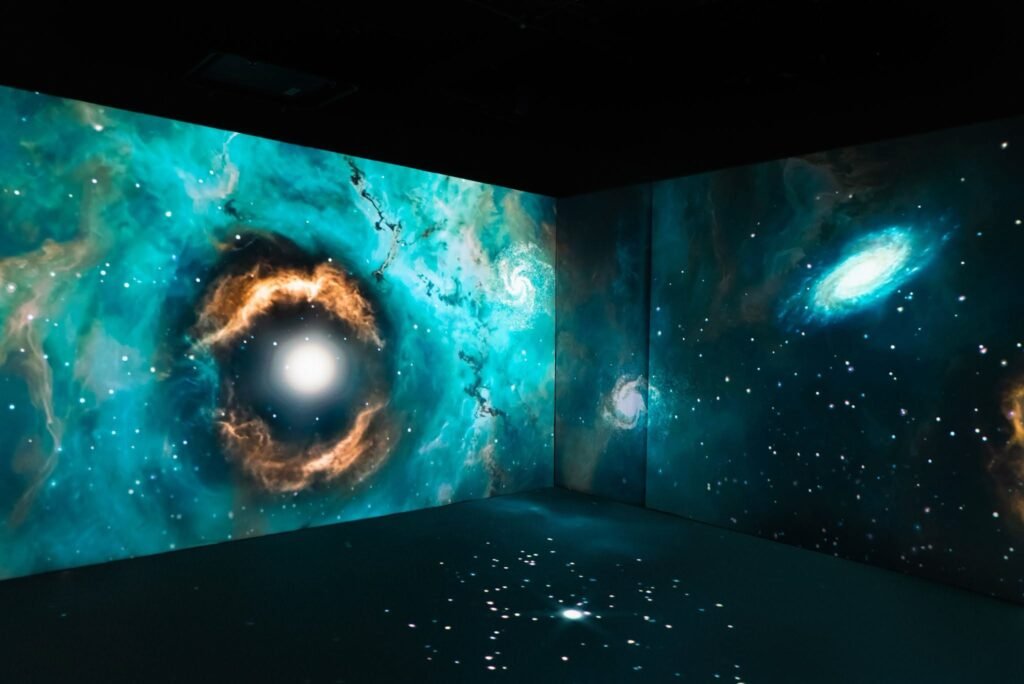
The exhibition unfolds across three rooms. Following the exploration of natural materials and craftsmanship, visitors enter an immersive cinematic space tracing how carbon formed in the earliest stars became diamonds deep within the Earth.
A soundscape narrated by Lucian Msamati and Kristin Winters brings together original work by artists including Mumsy Themba and Ecka Mordecai.
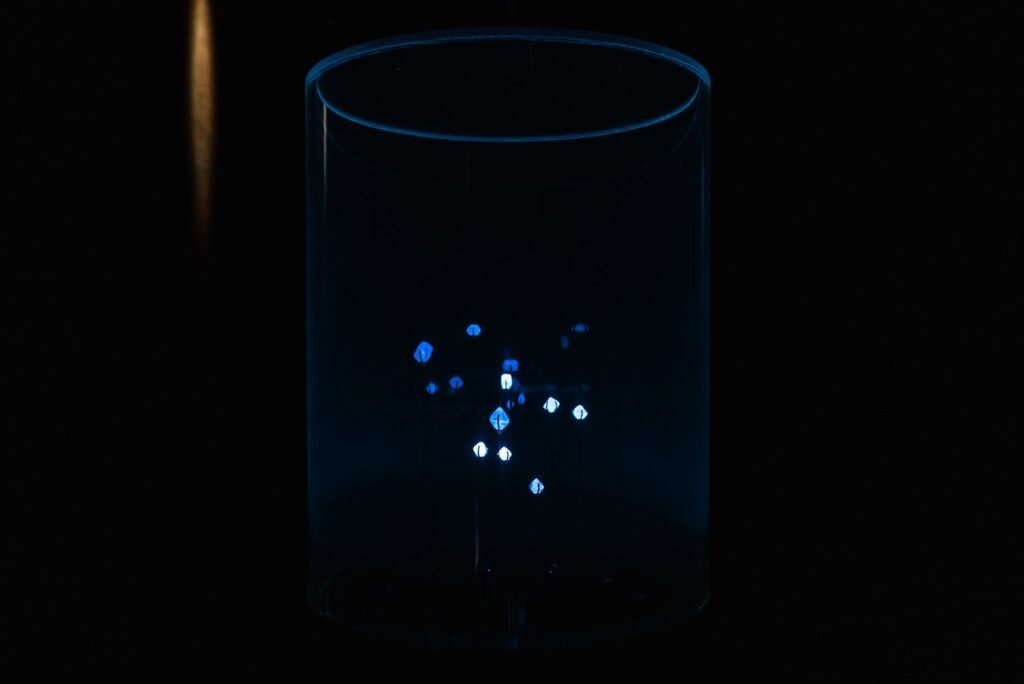
The final room turns attention to rough natural diamonds illuminated by ultraviolet light.
Some reveal a blue fluorescence, allowing visitors to observe a natural phenomenon that remains hidden under ordinary viewing conditions.
The stones are presented before cutting and polishing, offering a reminder that the finished diamond is only one stage in a much longer geological and creative process.
For De Beers, the installation builds on the first edition of Voyage Through the Diamond Realm, which travelled from London to Mumbai and New York. The second chapter is also expected to tour internationally following its presentation at Frieze Masters. Lynn Serfaty, De Beers’ general manager for natural diamonds, said the project explores the origins of natural diamonds through the connected ideas of creation and creativity, bringing together artists, craftspeople, actors and musicians from Botswana, the United Kingdom and France.
In the context of an exhibition devoted to diamonds, these practices become part of a wider conversation about the relationship between nature and human ingenuity. Botswana’s contribution is therefore more than a reference to the country’s importance as a source of natural diamonds.
The collaboration also raises a broader cultural question: what happens when traditional craft practices are placed within the international luxury art world?
For the Botswana artisans involved, the answer is not necessarily to abandon established techniques in pursuit of novelty.
Their contribution instead draws attention to the knowledge embedded in basketry, pottery, wood carving and textile work, practices through which materials are understood by touch, experience and repetition.
In the context of an exhibition devoted to diamonds, these practices become part of a wider conversation about the relationship between nature and human ingenuity. Botswana’s contribution is therefore more than a reference to the country’s importance as a source of natural diamonds.
It places its makers, materials and craft traditions within an international cultural narrative, suggesting that the story of a diamond begins long before it reaches a jewellery counter and involves considerably more than the stone itself.


