
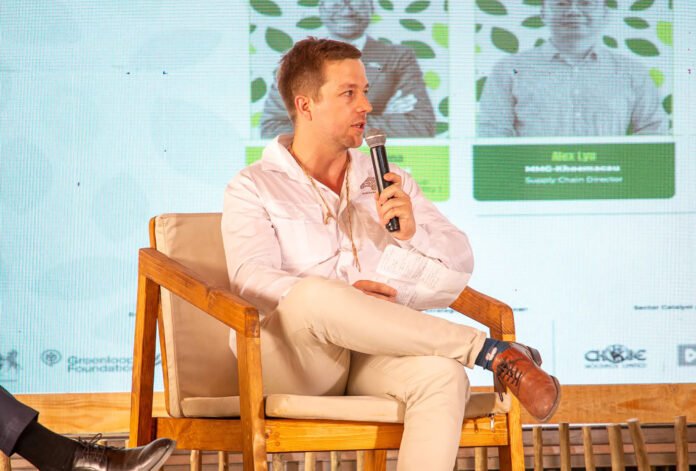


Machaba Safaris is seeking to expand procurement from communities surrounding its tourism operations, arguing that local producers should participate in the industry as commercial partners rather than remain recipients of corporate donations.
Speaking during a panel discussion at Botswana Sustainability Week at Sedia hotel in Maun on Wednesday, chief operations officer David Kind said tourism businesses could create wider economic benefits through their purchasing decisions, particularly by helping small local enterprises meet the standards required to supply established operators.
“As leaseholders, our biggest lever is what we buy and who we hire,” Kind said.
“At Ngoma Safari Lodge, a conversation with a farmer in Mabele became a business: Mr Jeremiah now supplies our kitchen weekly and employs seven people from Muchenje. He isn’t the recipient of a donation; he’s a supplier,” he said.
He cited the example of a farmer in Mabele whose relationship with Ngoma Safari Lodge developed into a regular supply arrangement, demonstrating how tourism procurement can create business opportunities and employment beyond the lodge itself.
“At Ngoma Safari Lodge, a conversation with a farmer in Mabele became a business: Mr Jeremiah now supplies our kitchen weekly and employs seven people from Muchenje. He isn’t the recipient of a donation; he’s a supplier,” he said.
Kind acknowledged that local procurement requires investment in the capacity of suppliers, including improvements to their business systems, training and the ability to meet operational standards.
“For a business our size, I’ll be honest: buying local is rarely the easiest option. The easy supplier is a big one in Gaborone or Johannesburg,” he said.
“Buying local means helping a supplier meet our standards, building their systems, training people. That capacity-building is done by our skilled managers, and it takes time.”
He said Machaba Safaris would continue shifting its supply chain towards communities around the areas in which it operates, supporting small businesses to become reliable suppliers.
The approach places local procurement at the centre of the debate on how Botswana can ensure that tourism creates economic opportunities beyond direct employment and the revenue generated by accommodation facilities.
Kind said the country’s natural attractions constituted an asset belonging to Batswana, with tourism providing a means of generating income from that asset over generations.
“I’m a finance person, so let me put it in finance terms. Botswana’s wild places are its natural capital, and they belong to the people of Botswana. Tourism is the interest they earn,” he said.
“Unlike a mineral, they can earn that interest for generations, as long as we never spend the capital.”
He argued that the economic benefits generated by tourism needed to reach surrounding communities if conservation was to remain sustainable over the long term.
“If the interest is too small, or isn’t shared fairly, the temptation to eat into the capital grows. That’s the temptation to poach and snare,” Kind said.
At Ngoma Safari Lodge, the company pays annual income to the Chobe Enclave Conservation Trust, which funds projects across five villages. In the Okavango Delta, it pays lease fees that go directly to surrounding communities.
Machaba Safaris also pointed to its community revenue-sharing arrangements.
At Ngoma Safari Lodge, the company pays annual income to the Chobe Enclave Conservation Trust, which funds projects across five villages. In the Okavango Delta, it pays lease fees that go directly to surrounding communities.
Kind said these arrangements needed to be supported by consistent enforcement of tourism management plans and lease agreements to protect the natural resources on which the industry depends.
“Management plans and leases are effectively the investment mandate for Botswana’s natural capital. So my ask is simple: enforce management plans and leases consistently and without exception,” he said.
He added that fair enforcement would help ensure responsible operators were not disadvantaged by competitors allowed to disregard the rules.
“When the rules are enforced for some and waived for others, the asset loses, and so do the communities who own it,” Kind said.
He said the priority is to build the capacity of small local businesses, expand community participation in tourism supply chains and ensure that the income generated by operations benefits the people living alongside the country’s wildlife areas.


