
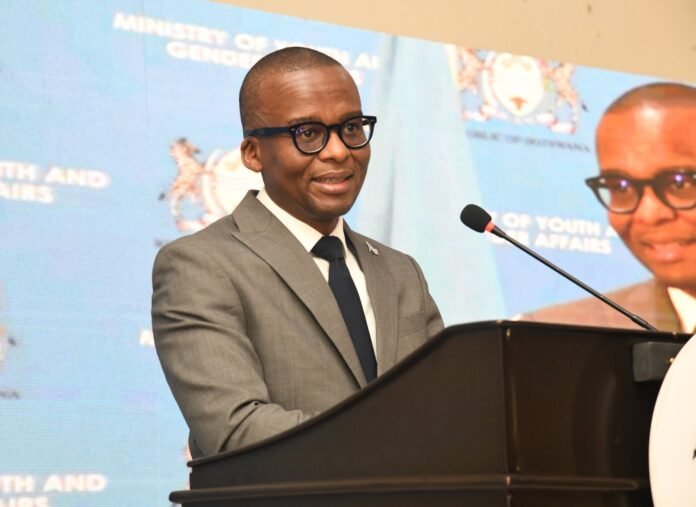


Vice President Ndaba Gaolathe has placed government accountability at the centre of youth employment debate, promising a mechanism to track commitments made to young people as the government confronts fiscal constraints and pressure to diversify its economy.
Addressing the Budget Pitso for Youth and Consultations on the State-Owned Enterprises Ownership Policy in Selebi-Phikwe on Tuesday, Gaolathe acknowledged that years of waiting for opportunities had weakened confidence in public institutions.
“We cannot dismiss those experiences and we cannot repair that confidence with speeches alone,” he said, confronting a fundamental question: how will government demonstrate that its promises are changing young people’s lives?
His proposed answer is a Youth Pitso Action and Accountability Report consolidating recommendations, identifying responsible institutions, setting measurable implementation milestones and explaining why proposals cannot be pursued.
“Every serious proposal deserves serious consideration and a clear response,” Gaolathe said, signalling a shift towards tracking government’s response rather than merely collecting public submissions. The proposal comes as Botswana faces mounting economic pressures. The World Bank’s Botswana Economic Update, Seizing the Moment: How Botswana Can Turn Crisis into Opportunity, identifies fiscal stability, private-sector growth, investment in skills and improved oversight of state-owned enterprises as priorities for sustainable job creation. Gaolathe acknowledged that government could not finance every ambition through public expenditure alone, arguing that each pula must deliver measurable value.
This principle extends to state-owned enterprises (SOEs), whose performance directly affects public finances, service delivery and the business environment. Gaolathe argued that poorly performing institutions consume resources that could otherwise support education, infrastructure and economic opportunities.
“We must increasingly ask what each pula achieves, what skill it develops, what investment it unlocks, what enterprise it enables and what opportunity it creates,” he said.
This principle extends to state-owned enterprises (SOEs), whose performance directly affects public finances, service delivery and the business environment. Gaolathe argued that poorly performing institutions consume resources that could otherwise support education, infrastructure and economic opportunities.
“The question is therefore not simply what Government should own, but how public ownership can deliver greater value for Batswana,” he said.
The International Monetary Fund has similarly called for stronger SOE management, reduced bureaucratic barriers, improved access to finance and greater private-sector participation to accelerate diversification and employment.
Beyond institutional reform, Gaolathe cited the proposed remodelling of the Youth Development Fund, work on a National Fund of Funds and the allocation of P200 million to the National Creative Industry Expansion Programme for 2026/27. The government has also approved the National Youth Policy 2026–2036.
“We must build an economy with more industries, more enterprises and more sources of opportunity,” he said.


