


Botswana faces a stark economic choice: move aggressively to build a diversified, private-sector-led economy or risk becoming trapped in a cycle of weak growth, shrinking reserves, rising debt and declining mineral revenues.
That is the central warning contained in the Botswana Economic & Investment Transformation Blueprint, Phase 1, prepared by Investment Bank of Africa (IBA), which proposes an ambitious 10-year investment programme requiring approximately US$62 billion (about P830 billion) in gross investment between 2026 and 2035.
The blueprint argues that Botswana’s economic advantage is no longer simply its diamond wealth but its institutions, pension savings, regional reputation, English-speaking workforce, conservation assets and proximity to South Africa.
It proposes transforming the country into a Southern African hub for finance, services, energy, specialised manufacturing and resource value addition.
The report’s assessment is that Botswana cannot afford to wait for another diamond-led recovery.
“The immediate challenge is to stabilise without freezing transformation,” the blueprint states. It argues that the first 12 months must simultaneously restore fiscal credibility and prepare projects capable of attracting private capital.
It warns that medium-term growth of around 3 percent would be inadequate to absorb new labour-market entrants, rebuild national buffers and achieve the country’s ambition of reaching high-income status by 2036.
The IBA says Botswana needs non-mining growth above 5 percent, private investment above 20 percent of GDP and sustained productivity improvements to cross what it calls the “transformation threshold”.
According to the blueprint, public debt increased from approximately 22 percent of GDP in 2023 to 40.7 percent in 2025, while the International Monetary Fund has warned that, without additional action, debt could approach 60 percent of GDP by 2030 and foreign reserves could be substantially depleted.
According to the blueprint, public debt increased from approximately 22 percent of GDP in 2023 to 40.7 percent in 2025, while the International Monetary Fund has warned that, without additional action, debt could approach 60 percent of GDP by 2030 and foreign reserves could be substantially depleted.
The report, however, rejects a conventional austerity response.
“The solution is not austerity alone,” it says, pointing instead to expenditure reprioritisation, improved non-mineral revenue collection, state-owned enterprise reform, asset recycling and private financing of commercially viable infrastructure.
The blueprint also points to the fragile nature of the country’s economic recovery. Botswana’s economy contracted in 2024 and 2025 as natural-diamond demand weakened and public expenditure came under pressure. Statistics Botswana subsequently recorded 3.5 percent year-on-year real GDP growth in the first quarter of 2026, although the report cautions that the rebound remains vulnerable.
The proposed transformation is built around four economic engines: regional services; resource value addition; nature and food systems; and productive infrastructure.Under regional services, Botswana would target financial services, fund administration, insurance, business-process outsourcing, data services, professional services, education and healthcare exports.
The resource-value-addition strategy would move the country beyond simply extracting minerals into diamond services, jewellery, copper and base-metal processing, mining technology, clean-energy inputs and engineering.
The third engine would exploit Botswana’s conservation and agricultural assets through high-value tourism, conservation finance, beef, leather, horticulture, nutraceuticals and climate-smart agriculture.
The fourth would focus on solar power, energy storage, electricity transmission, water reuse, logistics, serviced land, digital identity and public digital platforms.
The blueprint proposes a network of specialised economic hubs rather than attempting to develop every activity everywhere.
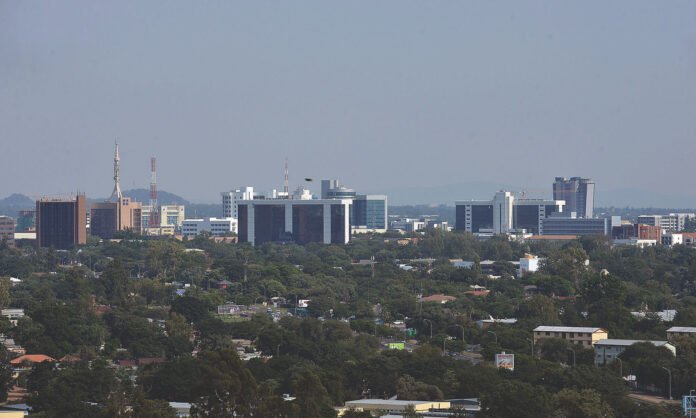
Gaborone would become the regional finance, digital, headquarters and professional-services centre, while Maun-Kasane would specialise in tourism, conservation and aviation.
Francistown-Palapye would be positioned as a trade, logistics, education and services corridor, while Selebi-Phikwe would focus on mining services, mineral processing, energy and circular industries.
Lobatse would anchor beef, leather, food processing and light manufacturing, while the Jwaneng corridor would focus on clean mining and diamond technology.
The blueprint argues that state-owned enterprises can provide stability and essential services but may also restrict competition, consume fiscal resources and prevent private firms from scaling.
It recommends retaining state ownership where there is a natural monopoly, strategic-security concern or demonstrable market failure, while using concessions, management contracts, minority private capital or divestiture where commercialisation is possible.
It also calls for quarterly publication of financial, operational and contingent-liability information for major state-owned enterprises.
The report recommends digital land administration, serviced industrial plots and statutory approval deadlines to reduce the time and cost involved in bringing investments to market.
For investors, the proposed model is deliberately transactional rather than promotional.
The central scenario envisages US$11 billion for power, water and climate resilience; US$9 billion for transport, logistics and land; US$9 billion for manufacturing and minerals; US$7 billion for human capital and skills; US$6 billion for digital and financial services; US$6 billion for agriculture and food; US$4 billion each for health, tourism and conservation, and urban and municipal infrastructure; and US$2 billion for project preparation and institutional capacity.
The government should create a single national investment pipeline, prepare bankable projects, establish data rooms, publish procurement calendars and provide investors with named government case managers.
“Market a small number of verified opportunities by sector and investor type—not a generic list,” the blueprint recommends.
Perhaps the most ambitious element is the proposed US$62 billion investment envelope.
The central scenario envisages US$11 billion for power, water and climate resilience; US$9 billion for transport, logistics and land; US$9 billion for manufacturing and minerals; US$7 billion for human capital and skills; US$6 billion for digital and financial services; US$6 billion for agriculture and food; US$4 billion each for health, tourism and conservation, and urban and municipal infrastructure; and US$2 billion for project preparation and institutional capacity.
IBA stresses that the figure is not a sovereign borrowing target.
Instead, it is intended to combine government expenditure, private investment, domestic institutional capital, foreign direct investment, development-finance institutions and public-private partnerships.
“Sovereign-funded investment should be concentrated in public goods, preparation and catalytic risk reduction,” the report states. Commercial assets, it argues, should be financed by users, operators, investors and lenders wherever feasible.
The blueprint also places Botswana’s pension savings at the centre of the transformation strategy, proposing project bonds, infrastructure funds and other vehicles capable of channelling domestic institutional capital into productive investments.
But it warns against using monetary policy as a shortcut for cheaper investment.
With inflation reaching 10.7 percent in June 2026, above the Bank of Botswana’s 3–6 percent objective range, the report says monetary policy must prioritise price and financial stability rather than artificially suppressing borrowing costs.
“Do not confuse access with subsidy,” it says, arguing that the sustainable way to reduce the cost of capital is to lower project risk, improve information, strengthen credit systems and create credible revenue streams.
Botswana’s heavy spending on education and health has not translated sufficiently into employment, productivity and enterprise creation.
The blueprint therefore recommends employer-led training, apprenticeships, stronger vocational education, digital skills and outcome-based funding linked to employment, certification and earnings.
The report proposes an immediate 100-day agenda involving a fiscal baseline, screening of the government’s 186-project pipeline, selection of 20 flagship projects, creation of a national risk register and establishment of a delivery dashboard.
Within 12 months, it wants project-preparation facilities, land and permit reforms, standard contracts and the first competitive tenders.
Within 24 months, it targets at least five major investment closes.
“The 186-project pipeline should be treated as a national opportunity set,” the blueprint says. “A smaller first-wave portfolio must be selected through strategic impact, readiness, fiscal affordability, commerciality and delivery-capacity tests.”


