


The World Bank has warned that Botswana’s efforts to diversify its economy away from diamonds risk being stalled by tightening financing conditions, mounting fiscal pressures and delayed structural reforms.
In its Macro Poverty Outlook, October 2026, the World Bank says that although the economy is expected to recover from two consecutive years of contraction, the rebound remains fragile and vulnerable to persistent weaknesses in the diamond market, inflationary pressures and dwindling fiscal buffers. The Bank projects economic growth of 3.4 percent in 2026, following contractions of 2.8 percent in 2024 and 0.7 percent in 2025. However, it cautions that the recovery does not necessarily signal a return to sustainable growth, particularly as the country’s dependence on diamonds continues to expose the economy to external shocks.
“Structural reforms and fiscal consolidation are essential for diversified and inclusive growth,” the report states. The warning comes as Botswana faces the difficult task of financing economic transformation while government revenues remain under pressure and borrowing costs stay elevated. The World Bank says the country’s longstanding reliance on diamonds has become an increasingly serious macroeconomic challenge, with the emergence of synthetic diamonds contributing to structural changes in the global market.
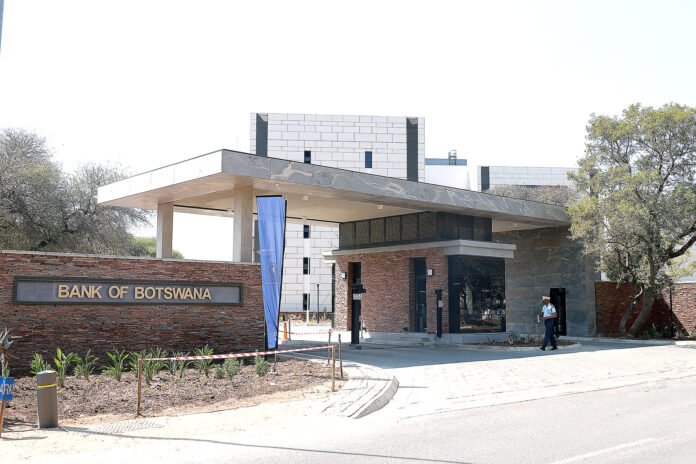
Public debt reached approximately 32.1 percent of GDP in the first quarter of 2026 as government increased borrowing to compensate for declining mineral revenues. The fiscal deficit is estimated at 5.9 percent of GDP, despite an improved 2025/26 financial-year outturn supported partly by a one-off dividend from the Bank of Botswana.
Mineral revenues have declined by approximately 10 percentage points of GDP over the past decade, weakening the government’s capacity to finance public expenditure and development programmes. The extent of the deterioration is illustrated by the changing contribution of mineral revenues to government finances.
“Mineral revenues, which two decades ago could cover up to two years of the public wage bill, now cover barely three months,” the report observes. The resulting mismatch between government expenditure and revenue has contributed to persistent fiscal deficits and a rapid increase in public debt. Public debt reached approximately 32.1 percent of GDP in the first quarter of 2026 as government increased borrowing to compensate for declining mineral revenues. The fiscal deficit is estimated at 5.9 percent of GDP, despite an improved 2025/26 financial-year outturn supported partly by a one-off dividend from the Bank of Botswana. The World Bank argues that fiscal adjustment will require government to mobilise additional revenue while rationalising expenditure. It also warns that the country’s limited fiscal space could constrain investments needed to unlock economic diversification, particularly in infrastructure, connectivity and energy. The Bank says improving the efficiency and targeting of public expenditure is critical to creating room for priority investments while strengthening the business environment to attract private capital.
“Business environment reforms” are among the measures identified as necessary to unlock private investment and promote private-sector-led growth. The recovery recorded in the first quarter of 2026 also raises questions about the strength of the economic rebound. The economy expanded by 3.5 percent year-on-year during the period, driven by improved mining activity, electricity generation, diamond trading and selected services.
However, the World Bank warns that the recovery could be misleading because increased diamond production has not translated into stronger export sales. Diamond production increased by 4.8 percent year-on-year in the first quarter, but De Beers’ sales declined by 23 percent in the first half of 2026, while diamond exports fell by 33.6 percent. The divergence between production and sales has contributed to an accumulation of diamond inventories, highlighting the danger of relying on increased output to drive economic recovery when global demand remains weak.
Household consumption also remains under pressure. The World Bank reports that household consumption contracted by 3.2 percent, while gross fixed capital formation declined by 10.4 percent during the first quarter. Growth was instead supported largely by inventory accumulation and public consumption, raising concerns about the sustainability of the recovery in the absence of stronger private-sector activity and household spending.
The World Bank also places Botswana among the world’s most unequal countries citing a consumption-based Gini index of 55. The Bank projects growth to settle at approximately three percent over 2027–2028, while warning that a sharper decline in global diamond demand could further undermine exports, government revenues and economic growth.
Inflation surged from 4.2 percent in March to 10.7 percent in June 2026, driven largely by higher fuel and food costs associated with the conflict in the Middle East. The increase has eroded household purchasing power, with poorer households disproportionately affected. The Bank of Botswana responded by raising the monetary policy rate to 5.5 percent in April, maintaining it at that level in June. High government borrowing has also kept domestic yields and lending rates elevated, further tightening financing conditions for businesses and households. The World Bank warns that these conditions could undermine investment and delay the expansion of economic activities outside mining.
The World Bank also places Botswana among the world’s most unequal countries citing a consumption-based Gini index of 55. The Bank projects growth to settle at approximately three percent over 2027–2028, while warning that a sharper decline in global diamond demand could further undermine exports, government revenues and economic growth. Other risks include higher fuel prices resulting from Middle East tensions, lower Southern African Customs Union (SACU) receipts, El Niño conditions and renewed foot-and-mouth disease outbreaks that could damage agricultural production, livestock exports and rural livelihoods.
It identifies tighter financing, delayed fiscal reforms and slow implementation of structural reforms as additional threats to diversification and private-sector-led growth.


