
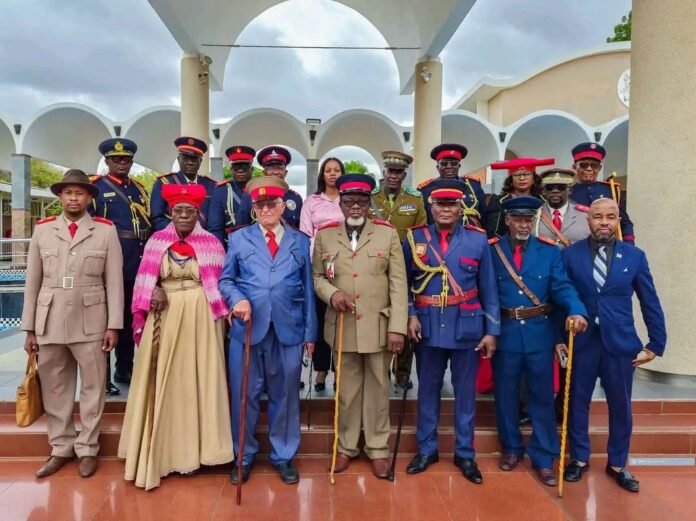


Members of the Ovaherero community in Botswana on Saturday marched from Trinity Church in Gaborone’s Main Mall to the residence of the German Ambassador, where they presented a petition calling for a just, inclusive and victim-centred reparations process for the genocide committed against the Ovaherero and Nama peoples between 1904 and 1908.
The petition argues that the consequences of the atrocities remain evident through land dispossession, forced displacement, cultural disruption and the exclusion of descendants from meaningful participation in decisions concerning their future.
It calls for concrete reparative action following Germany’s acknowledgement of the genocide and urges the inclusion of affected communities and their legitimate representatives, including those living in the diaspora.
Historians estimate that between 65,000 and 80,000 Ovaherero people or about 80 percent of their population, and around 10,000 Nama people were killed between 1904 and 1908.
The petition draws attention to one of the darkest episodes of Germany’s colonial rule in what was then German South West Africa, now Namibia. Following an uprising by the Ovaherero against colonial authorities in 1904, German forces under General Lothar von Trotha launched a campaign that historians widely regard as the first genocide of the twentieth century. After the Battle of Waterberg, thousands of Ovaherero were driven into the Omaheke Desert, where many died of thirst and starvation after German troops blocked access to water sources.
Survivors, along with members of the Nama community who later resisted colonial rule, were confined in concentration camps and subjected to forced labour.
Historians estimate that between 65,000 and 80,000 Ovaherero people or about 80 percent of their population, and around 10,000 Nama people were killed between 1904 and 1908.
Germany formally recognised the killings as genocide in 2021. However, debates over reparations and representation have continued, with some Ovaherero and Nama groups maintaining that descendants of victims have not been adequately involved in discussions on redress.


