
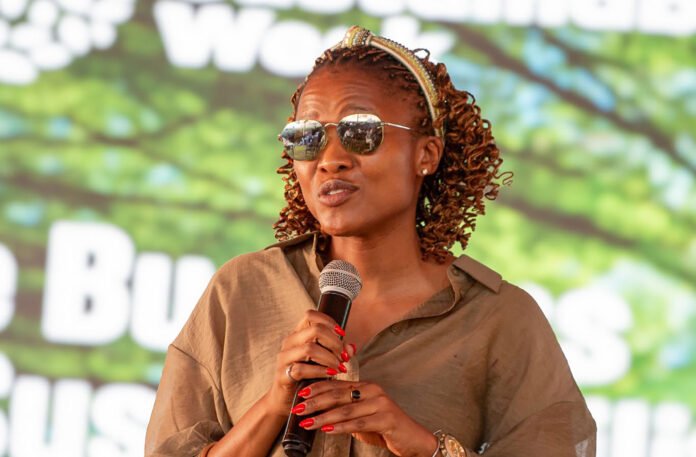

Green Loop Foundation founder Lindiwe Modise has called on businesses, government and development partners to translate sustainability commitments into concrete financial contributions, warning that limited investment and delayed decisions are slowing the growth of Botswana Sustainability Week.
Presenting the platform’s journey since its establishment in 2023, Modise said the initiative was created to connect sustainability ambitions with the people, expertise and financial resources required to implement projects that benefit communities and support enterprise growth.
“We created Botswana Sustainability Week to connect sustainability ambition with the people and resources needed to act,” she said in her founder’s address at the fourth edition of Botswana Sustainability Week, taking place at Sedia Hotel in Maun from October 21 to 23.
“We created Botswana Sustainability Week to connect sustainability ambition with the people and resources needed to act,” she said in her founder’s address at the fourth edition of Botswana Sustainability Week, taking place at Sedia Hotel in Maun from October 21 to 23.
The platform has expanded from 60 delegates at its inaugural gathering in 2023 to 350 participants in 2024. Attendance stood at 290 in 2025, when ministerial participation increased and the Tree Pledge Initiative was launched. This year, the foundation has signed memoranda of understanding with Chobe Impact, the impact arm of Chobe Holdings, and the Natural Selection Foundation, in a move intended to strengthen partnerships for sustainable development.
However, Modise identified limited investment, slow responses to partnership requests and insufficient traction in the One Million Trees Campaign as challenges that must be addressed if the platform is to deliver meaningful results.
“Investment remains low for a national platform intended to benefit us all,” the presentation states, highlighting the need for leaders and their teams to turn interest in sustainability into timely commitments. A central feature of the foundation’s funding model is the allocation of 25 percent of each partnership pledge towards collaborative project impact investing. Partners are expected to combine financial resources and expertise, while a roundtable process aligns priorities and coordinates project delivery.
The foundation says it will separately track pledges, funds received, project expenditure and community outcomes, with implementation dependent on the money actually received.
The proposed areas of investment include a needs assessment for Ngamiland, community projects and national impact initiatives. Partner contributions are also intended to support the sustainability platform itself and create opportunities for small, micro and medium enterprises (SMMEs). Modise said the ambition for Botswana Sustainability Week 2026 extends beyond convening stakeholders to producing practical project plans and securing commitments that can be implemented after the event.
Project groups are expected to identify challenges, anticipated benefits, required resources and proposed support, with the third day of the event intended to turn this work into plans and commitments.
Community priorities include advancing tree-planting pledges, distributing Hippo-rollers and household solar lights, and progressing planned community water-access work.
The platform also intends to connect local suppliers and Ngamiland crafts enterprises with buyers and potential partners through its marketplace, expanding opportunities for small businesses to participate in sustainability-related economic activity. The foundation plans to monitor and report on project plans over 12 months, with the stated objective of leaving behind funded initiatives and lasting livelihood benefits rather than commitments that remain on paper.
To improve delivery, Modise called on partners to treat annual outreach as a planning priority, include Botswana Sustainability Week and impact projects in their budgets, confirm contributions and payment dates, and appoint individuals responsible for following through on commitments.
To improve delivery, Modise called on partners to treat annual outreach as a planning priority, include Botswana Sustainability Week and impact projects in their budgets, confirm contributions and payment dates, and appoint individuals responsible for following through on commitments.
She urged potential partners to make clear financial commitments, bring in co-funders and support projects targeting the tree campaign, local enterprises and communities. Botswana Sustainability Week 2026 is being held under the theme, “The Business of Sustainability: Activating Private Sector Leadership to Drive Botswana’s Next Growth Economy.”
The platform brings together business, government and communities around the proposition that environmental responsibility can contribute to enterprise development, improved livelihoods and Botswana’s broader economic growth.
Modise, who has also been appointed Botswana Brand Ambassador for Land Restoration under the United Nations Convention to Combat Desertification, said the platform’s responsibility includes mobilising inclusive partnerships that translate restoration ambitions into local action.


