
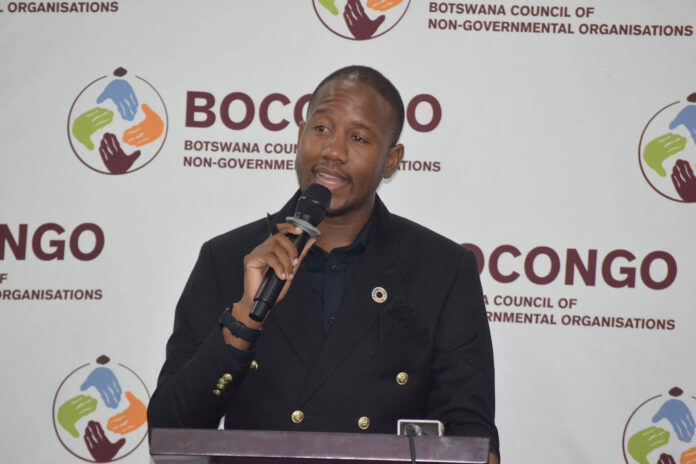

The civil society sector is facing a major financial shock after the Botswana Council of Non-Governmental Organisations (BOCONGO) confirmed that government subvention has been reduced to zero for the current financial year.
In an emailed response to News & All, Executive Director Kutlwano Pelontle confirmed the abrupt withdrawal of funding, saying the Council had received only a general notice of fiscal constraints, without detailed justification for the total cut. He says the move will immediately disrupt services particularly for rural and community-based organisations.
“BOCONGO can confirm that government subvention to the Council has been reduced to zero for the current financial year,” Pelontle said. He added that; “While we received official communication from the NGO Council outlining broader fiscal constraints affecting its budget, no detailed explanation has been provided regarding the specific basis for the complete withdrawal of funding to BOCONGO.” The decision, he warned, has immediate and far-reaching consequences for the organisation’s operations and its nationwide network of member NGOs.
“The impact is significant and immediate,” he said noting that government funding had historically underpinned core functions such as training, capacity building, advocacy coordination, and representation of civil society in policy spaces. Particularly vulnerable, he said, are smaller organisations operating in rural communities that depend heavily on BOCONGO for technical and institutional support.
“The organisations most affected by this gap will be smaller, community-based NGOs, particularly those in rural areas, who rely on BOCONGO for support they cannot otherwise access,” Pelontle said.
The organisation warned of wider implications for civic participation and government-civil society relations. BOCONGO reiterated its long-standing proposal for government to allocate at least one percent of the national budget to civil society support, framing NGOs as essential development partners rather than cost centres.
While BOCONGO is attempting to absorb the shock through resource reprioritisation and engagement with development partners, Pelontle warned that the gap cannot be filled quickly.
“We are actively working to mitigate this impact… but we would be understating the situation if we did not acknowledge that a full replacement of this funding will take time,” he said. He added that “some reduction in our service delivery to members is a realistic near-term risk.”
Pelontle said the scale and abruptness of the decision in Botswana was unexpected.
“A reduction to zero, with no transitional arrangement, was not anticipated by the Council and goes beyond what we understood the fiscal environment to require,” he said.
The organisation warned of wider implications for civic participation and government-civil society relations. BOCONGO reiterated its long-standing proposal for government to allocate at least one percent of the national budget to civil society support, framing NGOs as essential development partners rather than cost centres. “We do not view this funding decision as the end of that conversation, and we remain committed to working constructively with the government on this matter,” Pelontle said. He added that a well-resourced civil society sector strengthens governance and accountability rather than undermining it.
“A sustainably resourced, independent civil society sector is, in our view, a strength rather than a cost to any democracy,” he said. He further stated that“It supports public accountability, channels citizen voice into policy processes, and complements government’s own development objectives.”Despite the funding blow, BOCONGO says it remains committed to engagement and continuity where possible. “BOCONGO remains committed to its mandate of coordinating and strengthening civil society in Botswana, and to its long-standing, constructive relationship with government,” Pelontle said, adding that the organisation “would welcome the opportunity for further dialogue with the relevant authorities.”


