
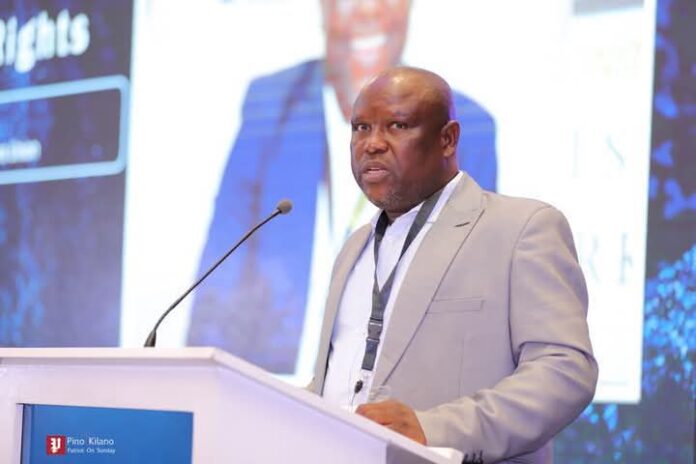


The Botswana Mine Workers Union (BMWU) has outlined a number of challenges it says continue to affect workers in the mining industry, despite existing legal protections.
Under Botswana’s Workers’ Compensation Act, mine workers who suffer injuries, occupational diseases or fatalities are entitled to seek compensation. However, BMWU president Joseph Tsimako says significant challenges remain.
“Limited inspection capacity at the Department of Mines, resource constraints by government and employers, delayed dispute resolution mechanisms, contract labour, outsourcing, and technological changes continue to place workers in vulnerable positions,” Tsimako told delegates at a mining summit this week.
“Economic downturns further intensify these challenges by increasing the risk of retrenchments, wage freezes and reduced investment in occupational health and safety. Some employees even end up purchasing their own protective equipment because of market downturns and cost-cutting measures.”
Tsimako said such circumstances highlight the critical role played by trade unions.
“This is where the union becomes very important. It serves as a bridge between workers, employers and government through collective bargaining, worker education, workplace monitoring and advocacy,” he said.
“The union strengthens compliance with both domestic and international labour standards. During periods of economic distress and labour market uncertainty, the union becomes even more important.”
He said the union negotiates fair retrenchment packages, protects workers’ benefits, advocates for employment opportunities and ensures that economic restructuring processes remain lawful, transparent and humane.
Tsimako added that the union also plays a significant role in promoting occupational health and safety within Botswana’s mining industry.
“Economic downturns further intensify these challenges by increasing the risk of retrenchments, wage freezes and reduced investment in occupational health and safety. Some employees even end up purchasing their own protective equipment because of market downturns and cost-cutting measures.”
However, he argued that structural and legislative barriers continue to hinder the union’s ability to fully discharge its mandate.
“Deep-seated structural and legislative impediments prevent the union from fully carrying out its responsibilities,” he said.
According to Tsimako, the union does not participate in certain statutory safety structures established under mining legislation, limiting its oversight role.
As a result, he said, the union often lacks access to incident reports from either government or employers and is unable to independently conduct safety audits or participate in investigations following workplace fatalities.
“This is a growing gap in an industry as old as ours,” Tsimako said.
He noted that greater union involvement would help reduce workplace incidents, improve compliance and enhance worker participation in workplace governance.
The union leader called on industry stakeholders to support efforts to close what he described as a legislative and administrative gap.
Tsimako also stressed the importance of social dialogue among government, employers and labour representatives.
“Effective cooperation between government, employers and BMWU reduces industrial conflict, promotes compliance and leads to better policy outcomes,” he said.
“This approach is fully aligned with international labour principles and provides a sustainable path for managing economic challenges within the mining sector.”
He said Botswana’s framework for protecting mine workers is shaped by a combination of international obligations, regional commitments and domestic legislation.
Tsimako warned that changing economic conditions and uncertainty in the global diamond market make strong labour institutions more important than ever.
The union called on government to strengthen labour inspections, modernise outdated legislation and develop joint strategies to ensure investors comply with labour laws. It also urged employers to improve transparency and increase investment in workplace safety.


