
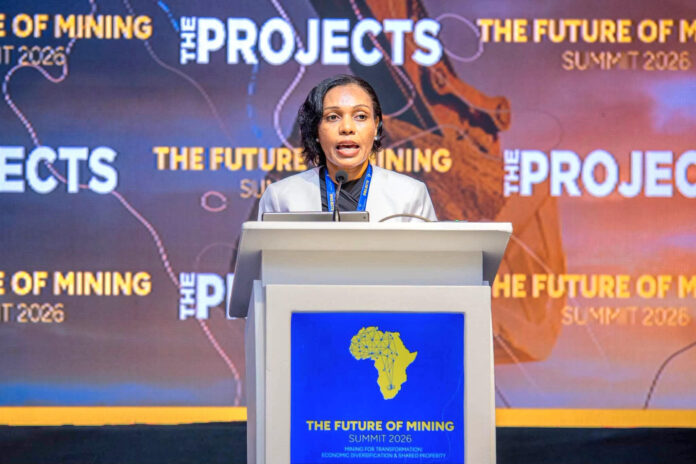


Mining companies risk undermining their long-term viability if they continue to treat community investment as a discretionary expense rather than a strategic business priority, De Beers’ Otsile Mabeo has said. Mabeo warns that declining production across Botswana’s mining sector is putting pressure on the industry’s social contribution.
Speaking at the Future of Mining Summit in Gaborone this week, De Beers Vice President for Social Impact and Sustainability, Mabeo, said companies must rethink how they approach their social license to operate as the sector deals with weaker commodity cycles and growing scrutiny from governments, communities and consumers.
“While operational performance follows the natural economic cycle, social investment behaves differently,” Mabeo said. “Declining sharply during contraction and recovering more slowly. This reflects its treatment as a discretionary rather than a strategic allocation.”
Her remarks come as the mining industry faces headwinds after a prolonged downturn in diamond demand that has affected production and revenues across the sector. Mabeo acknowledged that overall mining production in Botswana has declined over the past decade, reducing the value flowing back to communities that depend on the industry.
Mabeo argued that the global mining industry’s physical footprint is far smaller than many people assume, despite its outsized economic impact. According to estimates cited in his presentation, all mining activity worldwide occupies about 0.01% of the Earth’s surface, while diamond mining accounts for less than 1% of that area.
The challenge for mining companies, she said, is ensuring that investments in communities continue even during difficult periods.
“It is not only the right thing to do, it is right for business,” Mabeo said. “Corporations cannot divorce themselves from the very environment from which they obtain their social licence to operate.”
Mabeo argued that the global mining industry’s physical footprint is far smaller than many people assume, despite its outsized economic impact. According to estimates cited in his presentation, all mining activity worldwide occupies about 0.01% of the Earth’s surface, while diamond mining accounts for less than 1% of that area.
“Less than 1% of the 0.01% of the earth’s surface is in fact used for diamond mining,” she said.
Yet the industry has generated substantial economic benefits. Mabeo said the natural diamond sector has supported about 10 million livelihoods globally, while Botswana’s diamond industry has transformed the country’s economy since independence.
She pointed to the recently renewed partnership between De Beers and the Botswana government as an example of how mining companies can strengthen their social licence through long-term commitments.
Last year’s agreement extended Debswana’s mining licences to 2054 and secured a 10-year sales arrangement for rough diamond production through 2033. The deal also established a Diamonds for Development Fund with an agreed initial investment of P1 billion and commitments aimed at skills development and economic diversification.
According to figures presented by the company, De Beers generated US$2.9 billion in economic contributions across its producer countries and spent US$1.7 billion on inclusive procurement initiatives. The company said it has also supported more than 21,000 jobs within its operations and throughout its value chain.
“That commitment, beyond our commercial obligations, is where licence to operate lies,” Mabeo said.
According to figures presented by the company, De Beers generated US$2.9 billion in economic contributions across its producer countries and spent US$1.7 billion on inclusive procurement initiatives. The company said it has also supported more than 21,000 jobs within its operations and throughout its value chain.
A key focus of the group’s sustainability strategy is job creation beyond mining itself. Under its “Building Forever” framework, De Beers aims to support four community jobs for every one job created directly in its operations by 2030.
“We aim to support four jobs in our communities for every one job in our operations by 2030,” Mabeo said.
She argued that entrepreneurship development offers one of the most effective routes to economic diversification in Botswana, where most businesses remain small and informal. “Despite being a middle-income economy, Botswana has the enterprise profile of a low-income economy,” Mabeo said. “We have very many micro enterprises that operate basically at subsistence level with limited opportunities to grow and scale.”
To address that gap, De Beers has partnered with institutions including Stanford University, the Botswana government, Debswana, Anglo American and UN Women to support businesses at different stages of development.
Mabeo said the Stanford Seed programme has helped 109 companies across De Beers’ producer countries since 2018, contributing revenue growth of US$172 million, raising US$87 million in capital and creating thousands of jobs.
Examples include mining engineering firm Lucient Group, healthcare provider Village Oncology, agricultural producer Kwenantle Farmers, technology company Brastorne and drone-services firm Drones for Africa.
“Our licence to operate should therefore be our licence to collaborate,” Mabeo said. “It is critical that we align around national priorities, embed impact into our core business, and work through purposeful partnerships.”


